
Skip to content
nursing-com-website-logo
  • Learn
    • Courses
    • Study Plans
    • Study Tools
    • Practice Questions
    • SIMCLEX
  • Product
    • SIMCLEX
    • Certifications
    • Nursing School Survival Package
    • NCLEX Survival Package
    • Nursing Lifetime Survival Package
  • Coaching
  • Nurse Shop
  • Learn
    • Courses
    • Study Plans
    • Study Tools
    • Practice Questions
    • SIMCLEX
  • Product
    • SIMCLEX
    • Certifications
    • Nursing School Survival Package
    • NCLEX Survival Package
    • Nursing Lifetime Survival Package
  • Coaching
  • Nurse Shop
0
Your Cart
empty cart Your cart is currently empty! Return to Shop
Remove All Items
Are you sure? Yes / No
0 $0.00
View cart Checkout
Start Free Trial
Login
  • Learn
    • Courses
    • Study Plans
    • Study Tools
    • Practice Questions
    • SIMCLEX
  • Product
    • SIMCLEX
    • Certifications
    • Nursing School Survival Package
    • NCLEX Survival Package
    • Nursing Lifetime Survival Package
  • Nurse Shop
  • Login
  • Start Free Trial
0

Why Most Nursing Students Are Terrified of Pharmacology

(And How a Pair of SOCKs Changed Everything)

Authored by: Jon Haws, BS, BSN, RN, Alumnus CCRN
Nursing Content Reviewed by: Jon Haws, BS, BSN, RN, Alumnus CCRN

Jon Haws, RN is a nurse, educator, and founder of NURSING.com, dedicated to making nursing education easier and more effective. After facing burnout himself, he built NURSING.com to help students pass the NCLEX® with confidence and thrive in their careers.
Listen to Podcast
Download Cheatsheet
Take Quiz

I still remember the night before my first pharmacology exam.

3 AM. Energy drinks scattered across my desk. Hundreds of flashcards in disorganized piles. My eyes burning from staring at tiny drug names for hours.

And the worst part? I knew nothing was sticking.

Beta blockers, calcium channel blockers, ACE inhibitors, ARBs—the names swirled together in my mind like alphabet soup. The side effects lists seemed endless. The contraindications felt arbitrary. How was I supposed to memorize this much information?

Maybe you've had that same moment. Maybe you're having it right now.

The Numbers Don't Lie: We're All Feeling It

48% said they desperately needed better memory techniques for pharmacology

If so, you're not alone. In our recent survey of nursing students, 48% said they desperately needed better memory techniques for pharmacology. Another 39% admitted it feels impossible to keep track of and learn everything. And most telling of all? 0%—literally zero percent—said they felt confident about pharmacology.

That number haunts me. Not a single nursing student feeling confident.

But what if I told you the problem isn't you—it's the way pharmacology is taught?

Table of Contents

The Broken System of Pharmacology Education

nursing.com sock method for learning pharmacology
Take Quiz

Research confirms what we all feel: traditional pharmacology education is failing nursing students. A systematic review of teaching methods found that lecture-based approaches were among the least effective strategies for helping students retain pharmacological knowledge.

Meanwhile, the consequences are dire. One study revealed that graduating nursing students scored only 55% on pharmacology knowledge tests and 66% on calculation tests just before entering practice. More than a quarter didn't feel ready to deliver safe medication care.

Think about that. We're sending new nurses into practice feeling unprepared to administer medications—one of the most critical nursing responsibilities.

This isn't just an academic problem. It's a patient safety issue.

learn pharmacology 100,000 medication errors annually

The FDA receives over 100,000 reports of suspected medication errors annually. In the UK, medication errors cause nearly 2,000 deaths each year. That's one error for every five drugs administered.

As nurses, we're the last line of defense against these errors.

But here's the thing: most nursing programs are either cutting pharmacology from their curriculum entirely or drowning students in content without a framework to organize it all.

My Breaking Point (And Breakthrough Moment)

Take Quiz

By my third semester of nursing school, I was barely keeping my head above water in pharmacology. I had piles of drug cards, dozens of apps, and stacks of textbooks. But nothing helped me retain what I needed to know.

The turning point came during my MedSurg clinicals.

I was assigned to give Zofran to a patient with severe nausea. Before administering it, my clinical instructor asked me a simple question:

"How fast should you push that IV?"

I froze. I had memorized that Zofran was an antiemetic, that it was a 5-HT3 receptor antagonist, that its common side effects included headache and constipation.

But how fast to administer it? I had no idea.

That's when I sat down with my study buddy, Tarang . . .

He was quiet, soft-spoken — a trained pharmacist from India who sat next to me in pharm class. One night, we ended up studying together. Well, I was cramming. He was calmly sketching something in his notebook.

After watching me shuffle through a hundred flashcards, he looked over and asked, almost gently, "Jon, why are you trying to memorize the ocean?"

I laughed, but not because it was funny.

"Because that's what everyone studies pharm. Memorize. Drill. Repeat."

He shook his head, took out a clean sheet of paper, and began to draw.

A simple heart. A set of kidneys. Blood vessels branching out.

Then he pointed to his sketch.

"Beta blockers work here, Jon. ACE inhibitors work here. Diuretics affect this. When you understand where a drug works — which organs, which receptors — the side effects aren't just facts. They're predictable. They make sense."

That moment changed everything.

He wasn't just teaching me pharmacology.

He was teaching me to stop memorizing and start connecting.

To study with purpose. To think like a nurse.

I didn't know it then, but that conversation would become the foundation of what we now call the SOCK Method — a framework built not around memorization, but mastery.

Read the article "Prevalence of imposter syndrome and its association with depression, stress, and anxiety among nursing students: a multi-center cross-sectional study"

Listen to Podcast
Download Cheatsheet
Watch Lesson
Take Quiz

The SOCK Method: A Detailed Framework for Pharmacology Mastery

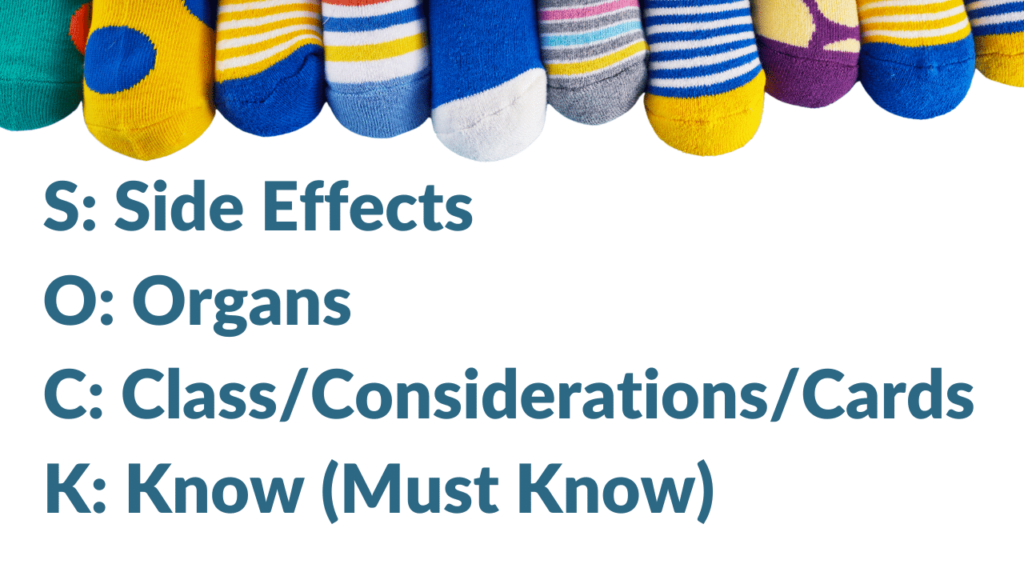
SOCK stands for:

  • S: Side Effects
  • O: Organs
  • C: Class/Considerations/Cards
  • K: Know (Must Know)

Let me break down exactly how to implement each component in your daily studying.
sock method for learning pharmacology hesi exam and nclex SOCK

Read the article "Occupational Burnout in Healthcare Workers, Stress and Other Symptoms of Work Overload during the COVID-19 Pandemic in Poland"

NURSING.com vs. Klimek Reviews – NURSING.com offers up-to-date lesson videos designed for NCLEX prep, including Next Gen NCLEX (NGN) questions. With expert-led, engaging content, NURSING.com provides nursing students with the best study tools to pass the NCLEX and succeed in nursing school. Compare NURSING.com vs. Klimek Reviews to find the best NCLEX prep solution.

Pass Your Tests,
Improve Your Grades

Enter a nursing topic and view videos and cheatsheet instantly
Free e-Book

77 Must-Know NCLEX Topics

what are the nclex flash notes gif flipping through pages showing text and cheatsheets
nursing.com team about photo

About NURSING.com

The leading platform for nursing education and NCLEX® prep. Recognized as a top innovator in nursing education, where over 1,000,000+ nursing students gain confidence, improve their grades, and pass the NCLEX®.

Creators of SIMCLEX®, the world's most advanced NCLEX® simulation exam.

Our mission? To end the nursing education struggle and help students become confident, competent nurses.

Learn More

Pass Your Tests,
Improve Your Grades

NURSING.com vs. Klimek Reviews – NURSING.com offers up-to-date lesson videos designed for NCLEX prep, including Next Gen NCLEX (NGN) questions. With expert-led, engaging content, NURSING.com provides nursing students with the best study tools to pass the NCLEX and succeed in nursing school. Compare NURSING.com vs. Klimek Reviews to find the best NCLEX prep solution.

Enter a nursing topic and view videos and cheatsheet instantly

What topic are you struggling with?

  • Signs of Pregnancy
  • Angina
  • Heart Failure
  • Hypovolemic Shock
  • Maslow's Hierarchy of Needs
  • Potassium
  • IV Complications
  • Hypertension

Take a practice quiz

  • Menstrual Cycle
  • Family Planning
  • Spinal Cord Injury
  • Addisons Disease
  • Hyperbilirubinemia
  • Hemodynamics

S: Side Effects That Actually Matter

The Problem: Most students try to memorize every possible side effect, which is both impossible and unnecessary.

The Solution: Categorize side effects into three critical groups:

  • Life-threatening side effects: These are your top priority. For example, with ACE inhibitors, angioedema is rare but potentially fatal. With digoxin, cardiac arrhythmias can be life-threatening.
  • Effects on major organs: Focus on how medications affect cardiac, respiratory, and neurological functions first—since these directly impact the ABCs (Airway, Breathing, Circulation).
  • "Opposite effects": Pay special attention to side effects that are the opposite of the intended therapy. For example, with insulin, severe hypoglycemia; with antihypertensives, rebound hypertension if stopped abruptly.

Practical Application:

  • For each medication you study, create a "side effect hierarchy" with these three categories.
  • Limit yourself to learning only 3-5 side effects per medication, focusing on those that fall into these critical categories.
  • For NCLEX preparation, prioritize side effects that would require immediate nursing intervention.

Example in Practice: For the antibiotic vancomycin, instead of trying to memorize its 30+ possible side effects, focus on:

  • "Red Man Syndrome" (life-threatening if infusion too rapid)
  • Nephrotoxicity (major organ effect)
  • Ototoxicity (major sense effect)

This approach immediately cuts your study load by 90% while ensuring you know what matters most for patient safety.

O: Organs (Applying the ABCs to Pharmacology)

The Problem: Students often treat all body systems equally when studying medications, causing them to miss critical effects on vital systems.

The Solution: Organize your medication study according to this organ system hierarchy:

  • Cardiac (highest priority)
  • Respiratory
  • Neurological
  • Renal
  • GI/GU
  • Integumentary
  • Musculoskeletal (lowest priority)

Practical Application:

  • For each medication, first understand its effects on the cardiovascular system, then respiratory, and so on down the list.
  • Assign a "primary system" designation to each drug. For example, beta blockers primarily affect the cardiac system, while bronchodilators primarily affect the respiratory system.
  • Create a color-coding system in your notes: red for cardiac effects, blue for respiratory, etc.

Example in Practice: When studying prednisone (a corticosteroid), you would prioritize understanding:

  • Its cardiac effects (fluid retention leading to hypertension)
  • Its respiratory effects (may mask infection symptoms)
  • Its neurological effects (mood changes, psychosis at high doses)
  • Its renal effects (increased fluid retention, electrolyte imbalances)

Only after understanding these would you focus on less immediately critical effects like osteoporosis or skin thinning.

Working Through a Specific Example: Let's say you're learning about metoprolol (a beta-blocker). Using the Organs approach:

  • Cardiac effects: Decreases heart rate and blood pressure
  • Respiratory effects: Can cause bronchospasm (contraindicated in asthmatics)
  • Neurological effects: May cause fatigue, dizziness
  • Renal effects: Minimal direct effects

This organization helps you immediately understand which effects need closest monitoring in different patient populations.

C: Classes, Considerations, and Cards

Classes: Learn Medications by Family, Not as Individuals

The Problem: Students try to learn each medication in isolation, missing the patterns that connect similar drugs.

The Solution: Focus on pharmacological classes first, then individual drugs.

Practical Application:

  • Start with class mechanisms: Before studying individual drugs, master how the entire class works. For example, understand how all ACE inhibitors block the conversion of angiotensin I to angiotensin II.
  • Learn class-wide characteristics: Identify side effects, contraindications, and nursing considerations that apply to the entire class.
  • Decode naming patterns: Memorize the common suffixes or prefixes for each class.
  • Master one prototype drug per class: Learn one medication from each class thoroughly, then understand how others in the class differ from the prototype.

Example in Practice: When learning about calcium channel blockers:

  • First learn that ALL calcium channel blockers prevent calcium from entering cardiac and smooth muscle cells, causing vasodilation.
  • Learn that they ALL can cause hypotension, dizziness, and constipation.
  • Note that most end in "-pine" (amlodipine, nifedipine).
  • Master amlodipine as your prototype, then learn how other CCBs differ.

Considerations: The Practical Aspects of Medication Administration

The Problem: Students focus on theoretical knowledge but miss critical practical aspects of giving medications.

The Solution: For each medication or class, identify key nursing considerations in three categories:

  • Administration concerns: Timing, route, compatibility, and special instructions.
  • Patient education: What patients need to know to take medications safely.
  • Monitoring parameters: What you need to assess before, during, and after administration.

Practical Application:

Create a "considerations checklist" for each medication class with these key questions:

  • How should this medication be administered? (IV push? Slow infusion? With food?)
  • What needs to be assessed before giving it? (HR? BP? Lab values?)
  • What ongoing monitoring is required? (Daily weights? Electrolytes?)
  • What must patients be taught about this medication?

Identify "high-alert" considerations that could cause serious harm if missed.

Example in Practice: For heparin administration:

  • Administration concern: Must be given via infusion pump, never IV push
  • Required assessments: PTT/INR before starting, recent bleeding history
  • Ongoing monitoring: PTT every 6 hours initially, signs of bleeding
  • Patient education: Report any unusual bruising or bleeding immediately

Cards: Creating Effective Study Materials

The Problem: Many students create disorganized or overly detailed drug cards that don't facilitate actual learning.

The Solution: Create streamlined, SOCK-method-based drug cards.

Practical Application:

  • Use a consistent template: Each drug card should have the same sections in the same order, following the SOCK method.
  • Be ruthlessly selective: Include only the most critical information in each section, not everything you know.
  • Use visual elements: Color-code by drug class, use highlighting for high-alert information, draw simple diagrams for mechanisms when helpful.
  • Create relationship cards: Besides individual drug cards, create cards showing relationships between similar medications or those used for the same conditions.

Sample Template:

Download Cheatsheet
Listen to Podcast
Download Cheatsheet
Watch Lesson
Take Quiz

K: Know (Must Know)

The Problem: Students waste time trying to learn every medication equally well.

The Solution: Apply the 80/20 principle to focus your learning on the medications you'll encounter most often.

Practical Application:

  • Create a three-tier system for medication priority: (Tier 1: Medications you'll use daily in almost any setting Tier 2: Medications commonly used in your specialty or area of interest Tier 3: Less common but important for NCLEX or specific situations)
  • Allocate your study time accordingly: Spend 60% of your time on Tier 1 meds, 30% on Tier 2, and 10% on Tier 3.
  • Keep a "clinical frequency" log: During clinical rotations, note which medications you administer most often and elevate those in your priority list.
  • Focus on medication clusters: Identify medications commonly given together (e.g., heart failure medications) and learn them as a group.

Example in Practice:

Tier 1 (Master These First):

  • Analgesics (acetaminophen, NSAIDs, opioids)
  • Common antibiotics (amoxicillin, azithromycin, cephalosporins)
  • Cardiovascular basics (metoprolol, lisinopril, furosemide)
  • Anticoagulants (heparin, warfarin, DOACs)
  • Insulin

Tier 2 (Master After Tier 1):

  • Specialty-specific medications (psych meds if working in psychiatry, chemotherapy if in oncology)
  • Less common cardiovascular medications
  • Respiratory medications
  • Gastrointestinal medications

Tier 3 (Learn for NCLEX and Specialized Situations):

  • Rare antidotes
  • Highly specialized medications
  • Medications with unique nursing considerations

Putting It All Together: The SOCK Method in Action

While I've called it SOCK for easy memory, the actual order you should follow when studying is:

  • O: Start with understanding major organ systems
  • K: Identify which medications you must know
  • C: Learn the classes, considerations, and create your cards
  • S: Master the side effects that matter most

Let me walk you through exactly how to apply this to your studying:

Step 1: Begin with Organ Systems (O)

Before diving into specific medications, review the pathophysiology related to the major organ systems. This creates the necessary foundation for understanding how medications work.

Action items:

  • Create a one-page summary of how each major organ system functions
  • Focus particularly on mechanisms that medications typically target (e.g., the renin-angiotensin-aldosterone system for cardiac meds)
  • Draw simple diagrams showing key receptors and processes that medications affect

Step 2: Identify Your Must-Know Medications (K)

Look at your course syllabus, clinical rotation schedule, and NCLEX preparation materials to identify which medications are most important right now.

Action items:

  • Create your three-tier list of medications (as described earlier)
  • For each clinical rotation, identify the 10-15 most common medications you'll encounter
  • Start with one drug class that appears frequently in your Tier 1 list

Step 3: Master Classes, Create Considerations, and Make Cards (C)

Now that you know which medications matter most, start learning them by class.

Action items:

  • For your chosen drug class, first understand the entire class mechanism
  • Identify the naming patterns for that class
  • Select one prototype drug from the class to learn thoroughly
  • Create a drug card for that prototype using the template provided earlier
  • Add critical administration and monitoring considerations
  • Create additional cards for other drugs in that class, focusing on how they differ from the prototype

Step 4: Focus on Critical Side Effects (S)

Finally, for each medication, identify and learn the most important side effects.

Action items:

  • For each drug card, add only the 3-5 most critical side effects
  • Categorize them as life-threatening, major organ effects, or opposite effects
  • Create a quick reference guide for side effects that require immediate intervention
  • Practice "what if" scenarios: "What if my patient on this medication suddenly shows this symptom?"

Weekly Study Plan Using SOCK:
Your Plan For Learning Pharmacology

Monday

Organ Systems Review (O)

  • Review pathophysiology related to the drug classes you're studying
  • Connect organ functions to medication mechanisms

Tuesday

Must-Know Medication Identification (K)

  • Identify a new drug class to focus on this week
  • Determine which drugs in this class are highest priority

Wednesday

Class Mastery (C - part 1)

  • Learn the mechanism for the entire drug class
  • Understand class-wide effects and considerations
  • Master the prototype drug for this class

Thursday

Individual Drug Cards (C - part 2)

  • Create drug cards for additional medications in this class
  • Focus on how they differ from the prototype
  • Add key administration considerations

Friday

Side Effect Focus (S)

  • Identify critical side effects for each medication
  • Practice clinical application through case scenarios
  • Review all components together

Weekend

Review and Clinical Connection

  • Test yourself with case studies
  • Make connections between different drug classes
  • Apply your knowledge to clinical situations

Real-World Application: Bringing SOCK to the Bedside

The true test of the SOCK method isn't just passing exams—it's applying this knowledge in clinical practice. Here's how each component translates to the bedside:

Side Effects in Practice

When you're administering medications, you'll automatically be alert to the most critical side effects. For example:

  • Before giving digoxin, you'll check the pulse rate (knowing bradycardia is a critical side effect)
  • After administering morphine, you'll monitor respiratory rate (understanding respiratory depression is the most concerning adverse effect)
  • For patients on corticosteroids, you'll be vigilant for signs of infection (knowing immunosuppression is a major concern)

Organ System Focus in Assessment

Your organized approach to medication effects on organ systems will structure your assessments:

  • For patients on antihypertensives, you'll check cardiovascular parameters first
  • For those on medications affecting the CNS, you'll include a focused neurological assessment
  • You'll know which lab values to monitor based on the organ systems affected

Class Knowledge in Drug Recognition

Recognizing medication classes becomes second nature:

  • When you see any medication ending in "-olol," you'll immediately recognize it as a beta-blocker
  • You'll anticipate similar effects and considerations for all medications within the same class
  • You'll naturally group medications by mechanism rather than treating each as a completely new entity

Prioritization Based on Must-Know Medications

Your clinical focus will shift based on medication importance:

  • You'll spend more time teaching patients about high-priority medications
  • You'll monitor more closely when administering high-risk medications
  • You'll be especially vigilant with medications known to cause frequent adverse effects

Common Challenges With Learning Nursing Pharmacology and How to Overcome Them

Even with the SOCK method, you'll face challenges. Here's how to address them:

Why The SOCK Method Works For Learning Pharmacology for NCLEX and HESI - When Nothing Else Does

The SOCK method works best for mastering nursing pharmacology because it aligns with how our brains naturally learn. Research in cognitive load theory suggests that our working memory can only handle a limited amount of information at once.

Traditional pharmacology teaching overloads your working memory by bombarding you with disconnected facts. The SOCK method creates mental frameworks—or schemas—that organize information logically, making it easier for your brain to process and store.

Studies support this approach. Research on nursing education has found that:

  • Teaching pharmacology by drug class improves knowledge retention
  • Reviewing pathophysiology alongside pharmacology leads to better understanding
  • Focusing on clinical applications rather than chemical structures increases both retention and confidence

This isn't just theory—it works. Students who have used the SOCK method consistently report higher grades, better NCLEX results, and most importantly, more confidence in their clinical practice.

Taking Your First Step: Creating Your SOCK System

Ready to try this approach yourself? Here's how to get started:

  • Download the SOCK Method Template: We've created a free guide that walks you through each step of the method, complete with examples and a drug card template.
  • Pick ONE Drug Class to Master First: Don't try to learn everything at once. Start with a common class like antibiotics or antihypertensives. Apply the SOCK method to just that group.
  • Create Drug Cards for the Top 3 Medications in That Class: Using our template (or your own), create detailed SOCK-based drug cards for the most common medications in your chosen class.
  • Test Your Knowledge Clinically: Rather than just memorizing, ask yourself clinical questions: "If my patient is taking this medication, what side effects should I be monitoring for?" "How would I teach a patient about this medication?"

This approach builds confidence quickly because you're learning deeply rather than broadly.

A Personal Invitation

I created NURSING.com because I believe nursing education needs to be more than lectures and textbooks. It needs to work with how nurses actually learn and practice.

The SOCK method isn't just an academic tool—it's a clinical framework that will serve you throughout your entire nursing career.

Inside NURSING.com, we've built an entire pharmacology mastery system around this method:

  • A complete MedMaster Course that teaches pharmacology using SOCK
  • Drug cards for 140+ must-know medications organized by the SOCK method
  • Visual mnemonics that make remembering drug classes effortless
  • Clinical scenarios that apply pharmacology knowledge to real patient situations

But you don't have to take my word for it. Try it for yourself.

We're offering a free 3-day trial so you can experience how different learning pharmacology can be when you have the right framework.

Remember: It's Not You, It's the System

Before I close, I want to remind you of something important: If you're struggling with pharmacology, it's not because you're not smart enough, not dedicated enough, or not cut out for nursing.

It's because you haven't found the right learning system yet.

The traditional approach to teaching pharmacology simply doesn't work for most students. It's not aligned with how our brains learn, how nurses practice, or what patients need from us.

The SOCK method changed my relationship with pharmacology—and ultimately my confidence as a nurse. It might just do the same for you.

So put on your SOCKs, and let's walk this path together.


❤️ Happy Nursing!

-Jon Haws, RN

Jon Haws, RN, BS, BSN, alumnus CCRN, is the founder of NURSING.com, an online learning platform that has helped over 400,000 nursing students pass the NCLEX and become safe, confident nurses. He developed the SOCK Method based on his own struggles with pharmacology during nursing school.

Have you tried the SOCK method?

References and additional reading:

  • Best practices for teaching pharm
  • Teaching Clinical Pharmacology to Undergraduate Nursing Students
  • Strategies to Inspire Students’ Engagement in Pharmacology Courses
  • Nursing students' pharmacological knowledge and calculation skills: Ready for practice?

🧦 Which SOCK Type Are You?

Discover your pharmacology study personality – and how to finally make pharm click.

Hear From Our Users Themselves

Alexis

Clyde

Elle

Rebecca

Richard

Mercedes

I Need This Support

NURSING.com One is trusted by nurses and nursing students at . . .

Recognized as a worldwide innovator in nursing education.

Learn More
fast company nursing education world changing idea

Fast Company
"World Changing Ideas"

Inc. 5000
"Fastest Growing Companies"

USPTO
SIMCLEX Algorithm Patent

NURSING.com Products

NURSING Academy

SIMCLEX

Certifications

Books

Flash Notes

Survival Packages

  • Nursing School
  • NCLEX
  • Lifetime

Nurse Shop

Get the best nursing gear

View Nurse Shop

For Nurse Educators

Enterprise Solutions

Free Educator Account

Happy Nurse Educator Podcast

Lesson Plan Templates

Schedule Free Demo

Free Resources

NCLEX Flash Notes

Cheatsheets

Podcast

Blog

Top Lessons

Care Plans

Preload vs Afterload

Respiratory Acidosis

Heart Sounds

Company

About

Compare Us

Contact

Reviews

Pass Rates

Our Educators

nursing.com site logo white
Facebook Instagram Pinterest Youtube Tiktok Linkedin

At NURSING.com, we believe Black Lives Matter ✊🏿, No Human Is Illegal 🤝, Love Is Love 🏳️‍🌈, Women`s Rights Are Human Rights 👩, Science Is Real 🔬, Water Is Life 🌊, Injustice Anywhere Is A Threat To Justice Everywhere ☮️.

© 2012-2025 NURSING.com All Rights Reserved.

Careers Medical Disclaimer Terms of Use Privacy Policy

Accessibility Sitemap Drug List

✕