TL;DR: A nursing brain sheet is a one-page survival tool that tracks time-sensitive patient information during your shift . . . medications, vitals, procedures, and tasks . . . so you don’t miss critical care moments or forget what to chart. Most brain sheets fail because they’re designed for textbook patients instead of real clinical chaos.
Why Your School’s Brain Sheet Template Probably Won’t Work in Real Life
I’ll never forget my first med-surg clinical. My instructor handed me this “perfect” brain sheet template with boxes for psychosocial assessment, cultural considerations, and patient education goals. I showed up day one with it beautifully printed, colored pens ready in my front pocket, feeling completely organized.
By 9 a.m., I’d written maybe three things on it.
Why? Because I couldn’t figure out what box to put anything in. My patient kept asking for pain meds, and I couldn’t find where I’d written down when the last dose was given or which meds were PRN. By 10 a.m., I’d completely abandoned the brain sheet and was scrambling to remember everything in my head—which obviously didn’t work.
Here’s what nobody tells you in nursing school: the brain sheets your instructors give you are designed for perfect theoretical patients from textbooks. You’ll never see these patients except on the NCLEX.
You need a brain sheet built for the real world. For chaos. For survival.
What Makes Most Nursing Brain Sheets Fail?
After working with over 200,000 nursing students (yes, that’s how many times our brain sheets have been downloaded), I’ve identified three critical reasons why most templates fail:
1. They Try to Be Your Entire Nursing Care Plan
Your brain sheet isn’t for documenting comprehensive assessments. That’s what your EMR is for. Your brain sheet is for survival in the trenches—quick reference information that keeps your patient alive and your shift manageable right now, today, during these 12 hours.
2. They Include Too Much Information You Don’t Actually Need
You don’t need your patient’s insurance information on your brain sheet. You don’t need their complete medical history dating back to childhood. You don’t need elaborate boxes and sections that look pretty but serve no functional purpose during a hectic shift.
What you DO need is information that answers one question: What keeps this patient alive today?
3. They’re Not Organized by Time
Nursing is fundamentally time-based. When are meds due? When was the last assessment? When are they going for dialysis? When did they last void? If your brain sheet isn’t organized around time-sensitive tasks, you’re going to miss things. Period.
This isn’t about being a “bad nurse”—it’s about using a tool that’s fundamentally broken for actual clinical work.
The 6 Essential Sections Every Nursing Brain Sheet Must Have
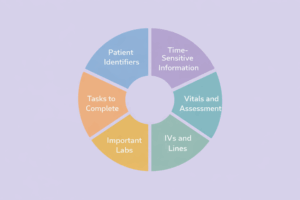
After years of real-world testing and feedback from hundreds of thousands of nursing students and practicing nurses, here are the only six sections your brain sheet actually needs:
Section 1: Patient Identifiers (The Basics)
- Room number
- Patient name
- Age
- Primary diagnosis (what got them admitted THIS time)
That’s it. You don’t need their complete medical history—just what’s relevant to this current hospital stay.
Section 2: Time-Sensitive Information (This Keeps Patients Alive)
This is the most critical section of your entire brain sheet:
- Scheduled medications with times – When is each med due?
- PRN medications – When were they last given? When can they have another dose?
- Procedures and tests – What time are they scheduled? Where do they need to go?
This section is literally what prevents medication errors and missed procedures. It’s your survival section.
Section 3: Vitals and Assessment (What Matters Right Now)
- Latest vital signs
- Relevant assessment findings from THIS shift
Notice I said “relevant.” You don’t need every assessment that’s ever been done. You need what’s important today, what’s changed, what you need to monitor. If your patient came in with chest pain, you need to know their cardiac status NOW, not their complete cardiac history from five years ago.
Section 4: IVs and Lines (What’s Running and Where)
- What IV access do they have?
- What’s running through each line?
- When was the IV placed? (Is it time to change it?)
- What fluids are they getting and at what rate?
Miss tracking this, and you could run into serious complications from infiltrated IVs or expired access points.
Section 5: Important Labs (Not All Labs, IMPORTANT Labs)
Not every lab value since admission. Just the labs that:
- Explain why they’re here
- Changed significantly during your shift
- You need to monitor for safety (potassium for cardiac patients, glucose for diabetics, etc.)
Section 6: Tasks to Complete (Your “Don’t Forget” List)
This is your safety net. Every shift has specific things you MUST complete:
- Dressing changes
- Documentation deadlines
- Patient/family teaching
- Discharge planning tasks
- Provider notifications
Write them down. Check them off. Don’t trust your memory when you’re managing multiple complex patients.
Everything else on traditional brain sheets? It’s just fluff.
How to Actually Use Your Brain Sheet During Your Shift
 A brain sheet isn’t a one-and-done form. It’s a living document that evolves throughout your shift. Here’s how to use it effectively:
At the Start of Your Shift
Get report from the previous nurse. Fill in what you know NOW. Don’t try to make it perfect—just get the critical information down fast. You can always add details later.
Throughout Your Shift
- Every time you give a medication → Mark it off with the time
- Every time you take vitals → Write them down with the time
- Every time something changes → Update it immediately
The brain sheet should be in your pocket, constantly being updated. It’s your second brain (hence the name).
At the End of Your Shift
Use your brain sheet to give report to the next nurse. Everything they need to know about what happened during your shift is right there. No scrambling to remember details. No “um, let me check the chart.” You have it all.
The 3 Biggest Mistakes Nursing Students Make with Brain Sheets
Mistake #1: Writing in Complete Sentences
Your brain sheet is for YOU. Use abbreviations. Use arrows. Use little pictures or symbols. Whatever makes sense to your brain in the moment. This isn’t formal documentation—it’s your personal survival tool.
Example:
- ❌ “Patient states that pain is currently at 4/10”
- ✅ “Pain 4/10 0930”
Mistake #2: Not Tracking PRN Medication Times
“The patient can have pain meds PRN” means nothing if you don’t know when they last had them. You need to know:
- What time was the last dose?
- How much did they get?
- When can they have another dose?
This seems minor until you have a patient in pain, you want to help them immediately, and you have NO IDEA if you can safely give them medication. Don’t let that be you.
Mistake #3: Trying to Squeeze Multiple Patients onto One Sheet
Just don’t. One sheet per patient. Otherwise you’ll cross-contaminate notes, miss information, and create a confusing mess that defeats the entire purpose of organization.
Yes, it means more papers in your pocket. It’s worth it.
What Makes Our Brain Sheets Different (And Why They Actually Work)
 I created these brain sheets after living through exactly what you’re experiencing. I’ve been the nursing student who forgot to chart bathroom visits. I’ve been the new grad who couldn’t remember which PRN med was due when. I’ve lived the chaos.
That’s why our collection includes 14 different brain sheet templates across 47 pages, because different clinical settings need different tools:
- Med-surg brain sheets for general floor nursing
- ICU brain sheets for critical care with more drips and lines
- Pediatric brain sheets adapted for smaller patients and weight-based dosing
- Mental health brain sheets focused on behavioral observations
- OB brain sheets for labor and delivery tracking
- And many more specialized templates
You’re not locked into one format. Try different ones. See what works for YOUR brain and YOUR unit.
Your Instructor Might Hate Your Brain Sheet (And That’s Okay)
Real talk: Your clinical instructor might not love that you’re using a different brain sheet than the one they provided. It might not follow their “perfect nursing care plan” format. It might not have all the theoretical boxes they think you need.
But here’s the truth: This brain sheet is for you, not for them.
At the end of the day, what matters is:
- Your patient is safe
- You’re completing all your care tasks
- You’re catching medication times
- You’re not forgetting critical information
A brain sheet that actually works will make you a BETTER nursing student and a safer nurse, which is what your instructor ultimately wants anyway.
Your instructor wants you to succeed. When you walk into patient rooms confident and prepared because you have a functional organizational system, they’ll see the results even if they don’t love your format.
How to Get Started with a Brain Sheet That Actually Works
Ready to stop drowning in disorganized notes? Here’s your action plan:
Step 1: Download our free brain sheet collection at nursing.com/brain-sheets – It includes 14 different templates across 47 pages, completely free.
Step 2: Print 2-3 different templates that might work for your clinical setting.
Step 3: Test them during your next clinical shift. See which one feels most natural to YOUR brain.
Step 4: Stick with what works. You might even customize your favorite by combining elements from different sheets.
Step 5: Master the five-minute head-to-toe assessment to pair with your brain sheet (more on this below).
The Perfect Companion Skill: The 5-Minute Head-to-Toe Assessment
Your brain sheet is only as good as the information you put on it. That’s why you need to master the quick, efficient head-to-toe assessment that fills in your brain sheet at the start of your shift.
Our 5-minute assessment video has been viewed over 5 million times because it teaches you how to perform a complete, competent assessment in just five minutes—not the 45-minute marathon your textbook describes.
Here’s the workflow that works:
- Get report → Fill in what you know
- Do your 5-minute assessment → Update your brain sheet with current findings
- Start your shift → Your brain sheet is now your command center
This is how professional nurses actually work. Not with theoretical perfection, but with practical systems that work in real time.
Real Talk: You Can Do This
 I know clinical feels overwhelming right now. You’re trying to remember everything, trying to meet your instructor’s expectations, trying to actually help your patient, and trying not to look completely lost in front of everyone.
Using a functional brain sheet won’t solve every problem, but it WILL give you a foundation. It will give you confidence. When your patient asks for pain medication, you won’t panic, check your sheet, see when they last had meds, and know exactly what you can offer them.
When your instructor asks about your patient’s morning blood pressure, you won’t blank, you’ll reference your sheet and give them exact numbers with times.
When you’re giving report at the end of your shift, you won’t fumble, you’ll have a clear, organized summary of your entire day.
That’s the power of a tool that actually works.
Download Your Free Brain Sheets Today
Don’t wait until your next clinical to get organized. Download all 14 brain sheet templates right now.
Over 200,000 nursing students have already downloaded these sheets. They work for students on med-surg floors, in ICUs, in pediatric units, in mental health facilities, and everywhere in between.
Find the one that works for you. Customize it if you need to. Make it yours.
And then go into your next shift with confidence, knowing you have a system that actually supports you instead of making your life harder.
You’ve got this. Go out there and be your best self.
Happy nursing!