Psst. . . I have a nursing riddle for you – to help you remember Angina!
Meet Nurse Abby
I’m Abby, RN!
 One of my favorite rotations was when I had the opportunity to work in the ER, because you just never know who is going to come in through the doors…
Patients who always got my heartbeat pumping were cardiac patients because those were always a challenge.
Sometimes as a nurse, your care is not isolated to just your actual patient.
What do I mean by that? I mean that being a nurse means that you people watch more than a normal person does. You can’t help but diagnose or suspect potential medical issues in people beyond your patient.
It’s like when you become an RN, something gets activated in your brain and it’s like you have a little bit of “hypochondria” for other people – you see symptoms and signs in people that aren’t your patients.
This happened to me when I was treating a patient in the ICU – my care went beyond treating just my patient – it extended to that patient’s SON.

The patient’s son started to say that he felt short of breath and he was having chest pain. All things that would be silent to any onlooker, but noisy warning signs to me, the nurse!
He was visiting his mom, so it would’ve been easy to assume that perhaps they were having anxiety being where they were. . .it was the ICU after all. . .
But something just didn’t feel right. . . enter in that special Nurse Brain.
I asked him when he started feeling this chest pain and he said that he’s been struggling with it for some time.
Me: How long do these episodes last?
Son: A couple of hours
Me: What does the pain feel like?
Son: It feels like an elephant is sitting on my chest. If I were to rate it, I’d say 10/10.
Me: Have you noticed this happening after you do a certain task or do you take anything to make it feel better?
Him: Well, I’m a smoker so I usually just chalk it up to smoker’s lungs but the pain is typically worse after exertion like if I use the stairs. But again, I thought that was just ‘cause I smoke. And I haven’t taken anything for it – it usually goes away after a second but this pain is something else. It feels like way more pressure than normal.
Me: Do you feel pain anywhere else? Or just your chest?
Him: No, my left arm hurts too. Am I having a heart attack?
Me: I’m not sure quite yet but I think we definitely need to get you admitted and get you checked out.
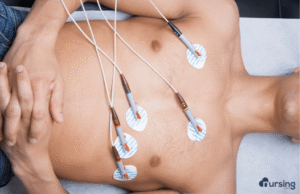
As it turned out, we hurried and hooked him up to the EKG, and he was actually having an MI, a myocardial infarction while visiting his mom.
This was a case of untreated angina that we were dealing with that led to an MI.
Did you catch that from the symptoms and solve the riddle? Are you ready to care for the next angina patient you meet? Check your knowledge now with a quick Angina Practice Quiz to see what your current level of understanding is.
Go ahead, I’ll wait . . . just click here.
How did you do?
Angina Pathophysiology
Okay, so let’s dissect this: Angina is a type of chest pain caused by ischemia (or a lack of oxygen) that starts from the HEART. This is important because there are patients who report chest pain for all sorts of different reasons:
There could be issues with other structures in the chest, like in the pleura tissue surrounding the lungs, or pericardial sac, which surrounds the heart. Even an anxiety attack can manifest as chest pain!
But ANGINA – the pain specifically starts at the heart because for one reason or another, those coronary arteries, the vessels that provide oxygenated blood to the heart and allow it to function properly, are blocked. This reduces the oxygenated blood flow (ischemia) to the heart, which causes anginal chest pain. It’s a sign of heart disease and it feels like a squeezing or heavy pain in the chest.
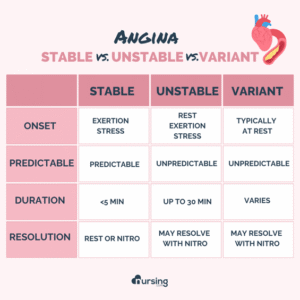
There are a few kinds of angina:
- Stable Angina:
- Common and happens during exercise or stress. It’s predictable and goes away with rest or medicine.
- Unstable Angina:
- Serious and happens even when resting. It’s unpredictable and could mean a heart attack is close.
- Variant Angina:
- Rare and caused by artery spasms. It happens while resting and is very painful. Symptoms include chest pain, feeling out of breath, tired, dizzy, sweaty, or nauseous. It’s important to take angina seriously and get medical help because it can lead to more heart problems. Treatment helps the heart get more blood, eases symptoms, and prevents other issues.
All that being said, angina is a vital symptom of a bigger, underlying issue.
We can say this because if perfusion is not taking place correctly in the heart, then we know perfusion to the rest of the body is at risk, too.
This is why it’s so important to listen to this symptom because it’s telling us the heart is starved of oxygen. It must be readily addressed, and treated before something worse develops, like an MI.
Angina is a common situation that you may deal with while working as an RN.
Let me share with you what helped me. I’ll show you what I did on nursing.com/ to master angina.
I stressed about my understanding, passing my class, and ultimately passing the NCLEX.
I found success when I started using nursing.com/ because it helped me find the must-know information with clear and concise videos, then I would check my knowledge with the lesson quizzes.
I used the SIMCLEX to not only evaluate if I was ready for the NCLEX, but it would also give me personalized suggestions on what I should study to fill in my knowledge gaps.
I could focus on those topics further with custom quizzes as well as using the additional study tools that are adapted to my personal learning style.

If you need some more resources and help you can find more at nursing.com/heart.
Now, to help build your angina knowledge, we are going to start piecing together the beginnings of an angina care plan.
Angina Care Plan
Angina is a common situation that you will deal with while working as an RN. Let me share part of my care plan with you, that I would use to help a patient with Angina.
Let’s start with the desired outcomes for the patient
Desired Outcomes for Angina Nursing Care:
- Symptom control
- Prevention of complications
- Improved exercise tolerance
- Medication adherence
- Enhanced quality of life
Subjective Data:
- Chest Pain
- Dyspnea on Exertion
- Do full pain assessment (PQRST or OLDCARTS)
- Ask about any doses of nitroglycerin or aspirin
Objective Data:
- EKG changes (arrhythmias)
- Hypotension
- Tachycardia
- Bradycardia
- Decreased SpO2
- Signs of decreased perfusion (cool, clammy, pale, diaphoretic)
Nursing Assessment for Angina:
- Clinical History:
- Obtain a comprehensive clinical history, including the onset, duration, and characteristics of angina symptoms. Inquire about any recent changes in the frequency or intensity of episodes.
- Risk Factor Assessment:
- Evaluate and document cardiovascular risk factors such as hypertension, hyperlipidemia, diabetes, smoking, family history of heart disease, and lifestyle factors (diet, exercise). Identify modifiable risk factors for targeted interventions.
- Physical Examination:
- Perform a thorough physical examination, focusing on cardiovascular parameters. Assess blood pressure, heart rate, respiratory rate, and signs of heart failure. Examine for peripheral edema and signs of poor perfusion.
- Pain Assessment:
- Use a validated pain assessment tool to quantify and characterize chest pain. Explore factors that alleviate or exacerbate pain, and assess the impact of pain on the individual’s daily activities.
- Exercise Tolerance:
- Evaluate exercise tolerance by assessing the individual’s ability to engage in physical activity without triggering angina symptoms. Determine any limitations or challenges related to exercise.
- Medication History:
- Review the individual’s medication history, ensuring adherence to prescribed anti-anginal medications and other cardiovascular medications. Inquire about any side effects or challenges with medication management.
- Psychosocial Assessment:
- Assess the psychosocial impact of angina on the individual’s mental health, emotional well-being, and overall quality of life. Explore coping mechanisms, stressors, and support systems.
- Educational Needs:
- Identify educational needs related to angina management. Assess the individual’s understanding of the condition, prescribed medications, lifestyle modifications, and the importance of seeking prompt medical attention for worsening symptoms.
Implementation for Angina Nursing Care:
- Medication Administration
- Educate the individual on the proper use of nitroglycerin for acute symptom relief and when to call for medical support
- Lifestyle Modification Support
- Cardiac Rehabilitation Referral
- Patient Education
- Monitoring and Follow-up:
Nursing Interventions and Rationales

Evaluation for Angina Nursing Care:

The entire Angina Care Plan along with 230+ other care plans are available on nursing.com/.
Looking for more? Visit nursing.com/heart now to download a Nursing cheat sheet for free.
I hope this has helped you understand Angina a bit better so you know what to look out for.
We’re rooting for you . . . Go out and be your best self today. . .
Happy Nursing!