A question I get from students pretty often is:
I am struggling with knowing how to break down the questions. I feel like I study and study, but I can’t get good grades on my exams and quizzes. I just started nursing school and I am in nursing basics and nursing assessment.
📝 What Different Types of NCLEX Questions Are There?
One of the best ways to defeat the NCLEX® is to know going into it what types of questions are going to be asked.
The NCLEX® is based on a set method for writing questions known as “Bloom’s Taxonomy for the Cognitive Domain“.
In fact, in the NCLEX®-RN test plan, the NCSBN states:
“Bloom’s taxonomy . . . is used as a basis for writing and coding items for the examination”
So, what exactly is Bloom’s taxonomy?
Here is a preview video from our Nursing Test Taking Course
Essentially it is nothing more than a method for classifying learning objectives and organizing them into levels of intellectual behavior and cognitive ability.
Originally it was developed to provide a congruent framework for teachers to write test questions and to serve as groundwork in developing learning goals for students.
It is important to understand that each succeeding level in Bloom’s Taxonomy builds upon the previous (ie it is impossible to create if you do not understand). In other words from remembering to create, the learner is required to call upon a higher level of cognitive ability.
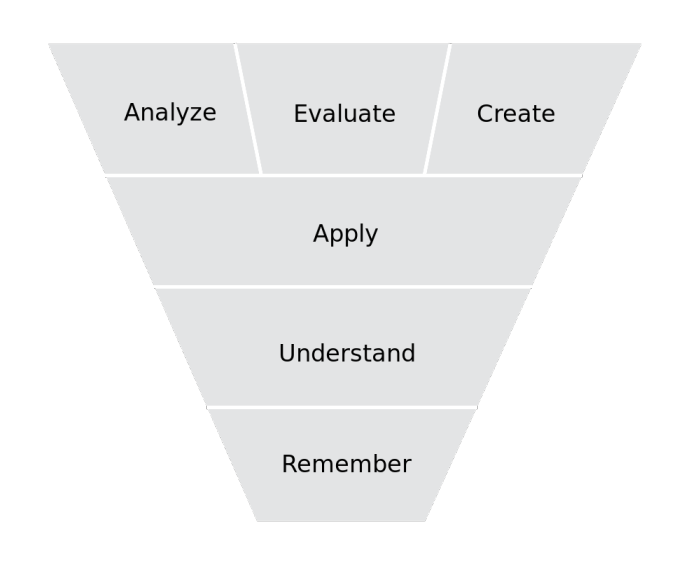
This classification was originally developed in 1956 but was revised in 2001 to include the following categories from simple to complex (Anderson & Krathwohl, 2001).
- Remember
- Understand
- Apply
- Analyze
- Evaluate
- Create
The NCSBN further states that:
“Since the practice of nursing requires application of knowledge, skills, and abilities, the majority of items are written at the application or higher levels of cognitive ability, which requires more complex thought processing.”
It’s for this reason the rumor goes around that if you have a lot of SATA (select all that apply) questions on your test then you must be doing well as these are considered to be at the evaluate level.
And this is why nursing educators repeat the catchphrase “critical thinking” . . . over, and over, and over . . . . and over.
Nursing schools UNDERSTAND that it is important for students to critically think in order to do well on nursing exams, but they often fail in educating students past the REMEMBER level of Bloom’s taxonomy . . . (see what I did there?).
Hence the 2-hour lectures with 4,746 slides that the instructor just glazes over. Or the “read pages 2-876 tonight and your test will be tomorrow”
Unfortunately, there are a couple of things wrong with a nursing education that limit the students’ ability to progress toward the ANALYSIS level:
- There is WAY too much to learn in nursing school in just a couple of short years
- Professors know how to say Critical Thinking, but they are not instructed on how to teach it
- Students aren’t taught or encouraged on HOW to ask the right questions
Without getting into the changes that need to occur in nursing education too much, I will simply say that as a nursing student it is your job to do a couple of things:
- Learn how to ask GOOD questions (your professor says Steroids cause osteoporosis . . . WHY???)
- Learn to cut the clutter (look at each chapter . . . what is the essential information to know?)
You now have a secret weapon. . .
You know exactly what TYPES of questions the NCLEX® is going to contain.
Begin now to train yourself to think at the analysis level. Take harder questions. This is the reason we have created analysis-level questions right into our massive bank of NCLEX® Questions!.
View nursing.com/ Test Taking Course
Parts of an NCLEX® Question
Now that you know what type of questions to expect on test day, let’s move on to the actual questions themselves.
The NCLEX® is composed entirely of multiple choice questions. Your ability to work as a nurse comes down to a single test with multiple choice answer options.
Think it’s important to understand a bit more about these questions?
How to Avoid Nursing Burnout
Basically, you have two options:
- Complain about the tests, the questions, and the answers.
- Learn everything you can about the questions and how to dissect them and demolish them.
Since only one of these options is going to get you closer to RN, let’s focus on learning how to dissect the questions.
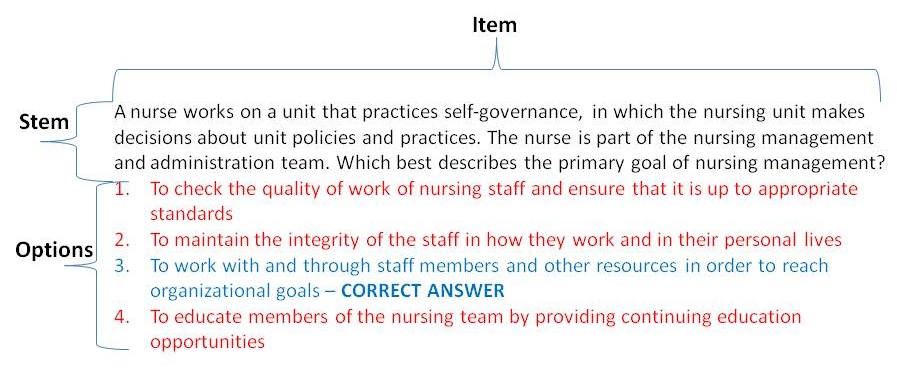
So let’s break down the anatomy of an NCLEX question, there are basically 5 parts of a question – which I outline below:
- Item: the entire question and answer
- Stem: the actual question, what is being asked
- Options: possible responses
- Correct answer: umm, the correct answer
- Distractors: incorrect answers
Stem:
There are 4 different ways a stem will be written on the NCLEX exam:
- Complete sentence
- Incomplete sentence – becomes complete with the correct answer
- Positive – asks a question regarding what is true
- Negative – asks a question regarding what is false. Be very careful with these questions. These tend to be missed more often simply because students fail to read the entire question. ALWAYS read the entire stem carefully and completely.
To help you identify a negative stem, look for these words as you read the stem:
- Except
- Not
- Never
- Further
- Least
- Avoid
- Contraindicated
Sometimes these items will be identified with bold or italic lettering but ultimately it is your job as the student to read the question and identify what is actually being asked . . . so read carefully.
The Nursing Process
The nursing process is the foundation of everything we do for our patients. Like it or not, understanding the nursing process is key to your success in nursing school and on the NCLEX. And when it comes down to it, the nursing process is essentially what a nurse does for 12 hours during each shift. In fact, it seems that for new nurses, a shift happens about 6 months into working as a nurse, and things just “click” – they finally feel like a “real nurse” . . . this is usually when the nursing process has become second nature.
So what is the nursing process anyway?
ADPIE . . . sound familiar?
It should . . . if those 5 letters mean nothing to you, then it is time to crack open your fundamentals book and review the nursing process.
What is the Nursing Process:
- A- assessment
- D- diagnosis
- P- plan
- I- implement
- E- evaluate
Because problem-solving and critical thinking requires a framework to conduct appropriately, nursing (as a profession) has developed the ADPIE framework to aid in decision-making with regard to patient care . . . it’s really no different from the scientific method.
For the purpose of the NCLEX, it is important to treat ADPIE as a rigid set of steps . . . meaning that you don’t implement a plan until you have assessed the patient. You don’t make a plan until you have a working diagnosis.
When reading a question it is important to identify which component of the nursing process the question is actually referring to and to select an answer that is in line with that component.
It is also essential that you work through the nursing process step by step as discussed above.
How to Answer Any SATA Question (the SATA Success Pyramid)
🤔 NCLEX Practice Questions
Now that you know HOW to break down NCLEX questions, it’s time to start practicing. To help you with this we have opened up our entire bank of nursing practice questions.

This resource is called Nursing Practice Questions and provides you with feedback, detailed rationales, global ranking and so much more to help you know exactly how you are doing.
Putting it together
These three elements are not the end all be all to answering questions, but when used together, these three strategies will help you to identify what is actually being asked, and help you eliminate incorrect answers.
11 NCLEX Test Tips
References:
Anderson, L.W. & Krathwohl, D.R. (Eds). (2001). A taxonomy for learning, teaching and assessing. A revision of Bloom’s taxonomy of educational objectives. New York: Addison Wesley Longman, Inc.