I had forgotten how much studying I had to do in nursing school.

This week I opened up some old nursing school notes, and I started remembering how hard nursing school really was!
I remember, in particular, getting a little confused between the different types of shock. When I was studying distributive shock I found one key 🔑 point that actually cleared up a lot of the misunderstandings and confusion. That started to really turn things around for me in nursing school!
So what worked for me was figuring out that key 🔑 point that helped clarify the different types.
Most people think of ‘shock’ as emotional distress or sudden fright in response to a traumatic event. But in nursing terms, shock is when you do not have enough blood circulating around your body.
So distributive shock is a type of shock in which blood is not being “distributed” as it should be – hence the name distributive shock.
Meet Nurse Abby
Hi, I’m Abby and today I am a practicing Registered Nurse . . .

. . . but I remember during nursing school I struggled to figure out the difference between distributive shock and other types of shocks, like,
– What is the difference between septic shock and distributive shock
– Or maybe. . . anaphylactic shock and distributive shock
– Or even . . . neurogenic shock and distributive shock
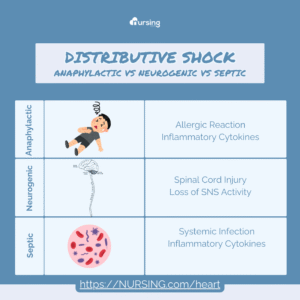
Maybe you caught on quicker than I did, but distributive shock is the bucket that the other three fall in. So septic, anaphylactic, and neurogenic are all types of distributive shock.
All three of them have a common symptom or response that interferes with vascular tone and causes massive peripheral vasodilation, which disrupts “distribution” of blood throughout the body.
⬆️ This is the key 🔑 to knowing that we are dealing with distributive shock.
Now, before we really dig in here, if you click the button below you can take a quiz on distributive shock to check your current level of understanding. Go ahead and take that quiz right now and then I’ll tell you a bit more about the different types of distributive shock.

Go ahead, I’ll wait . . . just click here.
How did you do?
Now back to the story…
I mentioned massive peripheral vasodilation is the key 🔑 to knowing that we are dealing with distributive shock, but why is that?
Let’s dig into the Anatomy and Physiology of the circulatory system for a minute.
- Under normal conditions, the blood flows from the heart to the essential and non-essential organs, and tissues and back again through the vessels.
- But if there is a problem with the vascular tone, blood pressure suffers causing the blood to pool in the periphery instead of circulating through the body and back to the heart like normal.
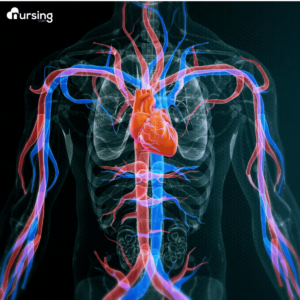
What effect will this have?? If the blood is pooling, instead of circulating, that equals lower blood pressure and reduces blood perfusion to the tissues and organs.
If there is not enough pressure or blood volume in the vessels, blood and oxygen have trouble reaching the brain. So in this case, you will start to see confusion in the patient.
Reduction of flow also affects the kidneys and means they will not function properly, so there will be decreased urinary output.
These are a few signs and symptoms of distributive shock, but let’s dig a little deeper into the specific types of distributive shock:
- Septic shock
- This will probably be the most common case of shock you will deal with in a hospital. It was for me.
- Septic shock develops from an overwhelming infection. The infection causes an immune response which interferes with vascular tone and we get the problems we were just talking about
- For more details specifically on septic shock we have a Septic Shock Case Study that you can review.
- Anaphylactic shock
- This is similar to septic shock, but instead of an infection causing an immune response, it is an allergic reaction causing the immune response and interferes with vascular tone.
- For more info on just anaphylactic shock, we have a Nursing Care Plan for Anaphylaxis to help you study.
- Neurogenic shock
- This is different from septic or anaphylactic shock, instead of the problem involving the immune system, the problem is caused by a loss or disruption of the sympathetic nervous system.
- This is a result of an injury to the spinal cord. The injury causes a decrease in sympathetic nervous system activity which results once again in interference with the vascular tone.
- Normally, the heart would try to compensate and beat faster when it senses lower blood volume, or hypotension. However an important symptomatic difference between neurogenic shock and the others under the umbrella of distributive shock, is that a patient experiencing neurogenic shock actually experiences bradycardia due to SNS disruption.
- So, remember, when there is interference in vascular tone the blood will start to pool in the peripherals instead of circulating as expected, and could lead to distributive shock.
These are common situations that you will deal with while working as an RN.
I stressed about passing my classes and ultimately passing the NCLEX when i was in nursing school. As mentioned above for a lot of nursing school I was overwhelmed by how much time I had to devote to studying
I found success when I started using nursing.com/ because it helped me find the must-know information with clear and concise videos, and then I would check my knowledge with the lesson quizzes.
I used the SIMCLEX to not only evaluate if I was ready for the NCLEX, but it would also give me personalized suggestions on what I should study to fill in my knowledge gaps.
I could focus on those topics further with custom quizzes as well as using the additional study tools that are adapted to my personal learning style.

Distributive Shock Pathophysiology
Identifying Distributive Shock
First, let’s quickly look at the difference between our two main types of shock so you can see the differences. Then we will break down distributive shock into its 3 main types.
| Distributive Shock | Cardiogenic Shock |
| Inflammation creates widespread dilation of blood vessels, leading to hypotension and insufficient circulatory volume. | Total, or almost total pump failure, because the heart is damaged or malfunctioning. Inadequate circulation for the body’s needs. |
| Common types include septic shock, anaphylactic shock, and neurogenic shock. | Common causes include: myocardial infarction, cardiac arrest, cardiomyopathy, or arrhythmias. |
| The problem is not the heart’s ability to pump blood but the loss of circulatory volume due to vessel dilation. | Symptoms arise from the heart’s failure to supply adequate blood to organs, leading to organ dysfunction. |
| Treatment aims to restore proper blood vessel tone, improve blood volume, and address the underlying cause of the shock (e.g. infection, allergic reaction, or noxious stimuli) | Treatment focuses on improving heart function and may include medications, mechanical support, or surgery. |

Distributive Shock Signs and Symptoms:
- Anaphylactic
- Hives, rash, swelling of arms, trunk, or face/mouth
- Exposure to allergen
- ↓ SpO2
- ↓ BP
- ↑ HR
- ↑ RR, wheezes
- Warm, flushed skin
- Neurogenic
- Spinal cord injury in last 24 hours
- Warm flushed lower extremities
- ↓ BP
- ↓ HR (occasional)
- Priapism (due to vasodilation)
- Septic
- ↓ LOC
- ↓ BP
- ↑ HR
- Warm, flushed skin
- ↑ Temperature
- s/s infection
Distributive Shock Therapeutic Management:
- Anaphylactic
- Epinephrine – stop reaction
- Corticosteroids – ↓ inflammation
- Bronchodilators – protect airway
- Neurogenic
- Therapeutic hypothermia = neuroprotective
- Supportive care x 24hrs – 2 weeks
- Septic
- IV antibiotics (blood cultures first)
- IV fluids to ↑ preload
- Corticosteroids only if vasopressors ineffective
- Decompensated Shock
- Vasopressors
- Intubation for airway protection
Diagnostic Tests for Distributive Shock:
- Carry Epi-pen on you at all times
- s/s infection – report to the health care provider
- Infection control precautions
- What to possibly expect with neurogenic shock (may last up to 2 weeks)
If you are still looking for those moments where everything clicks and you start to think like a nurse. . . what worked for me what nursing.com/ – and for more specifically on the heart you can go to nursing.com/heart.
Now, to help build your distributive shock knowledge and start piecing together the beginnings of a distributive shock care plan.
Distributive Shock Care Plan
Distributive shock is a common condition you will deal with working as an RN. Let me share part of my care plan with you, that I would use to help a patient with distributive shock
Let’s start with the desired outcomes for the patient
Desired Outcomes for Distributive Shock Nursing Care:
- Restoration of adequate tissue perfusion and oxygenation.
- Stabilization of hemodynamic parameters (blood pressure, heart rate, urine output).
- Identification and treatment of the underlying cause of shock.
- Prevention of complications such as organ failure.
Subjective Data:
- Patient reports of symptoms related to the underlying cause (e.g., infection, allergic reaction).
- Anxiety or distress due to the acute condition.
Objective Data:
- Signs of hypotension and tachycardia.
- History of recent events or conditions (e.g., trauma, spinal injury, exposure to allergens).
- Altered mental status or decreased level of consciousness.
- Laboratory findings indicating the underlying cause (e.g., infection markers, allergen-specific IgE).
- Hemodynamic monitoring data (e.g., central venous pressure, cardiac output).

Nursing Assessment for Distributive Shock:
- Continuous monitoring of vital signs and hemodynamic status.
- Assess for signs and symptoms of the underlying cause.
- Evaluate response to treatment interventions (fluid resuscitation, vasopressors).
- Monitor for complications like acute renal failure or respiratory distress.
Nursing Interventions and Rationales for Distributive Shock

Evaluation for Distributive Shock Nursing Care:
The entire Distributive Shock Care Plan, along with 230+ other care plans, are available on nursing.com/.
Looking for more? Visit nursing.com/heart now to download a Nursing cheat sheet for free.
I hope this has helped you understand distributive shock a bit better so you know what to look out for.
We’re rooting for you . . . Go out and be your best self today. . .
Happy Nursing!