How Drawing Helps Nursing Students Understand and Remember Hard Concepts
There is a moment a lot of nursing students have early in their science courses when they realize something important. Reading harder does not always mean learning better.
You can spend hours staring at pages of anatomy, physiology, med surg, pharmacology, and pathophysiology and still feel like none of it is really clicking. The words blur together. The details pile up. And by the end of the study session, it feels like you worked hard without actually building understanding.
That is where drawing can completely change the game.
A lot of students think drawing is just for people who are artistic. It is not. In nursing school, drawing is a study tool. It helps you organize ideas, connect steps in a process, and remember information more clearly. More importantly, it forces you to simplify what you are learning. And when you can simplify it, you usually understand it.
That is the real win.
Why drawing works so well in nursing school
Nursing content is dense. It is not just a list of facts. It is a giant network of systems, causes, effects, medications, complications, and nursing interventions. If you only try to memorize words, you miss the relationships between those pieces.
Drawing helps you see those relationships.
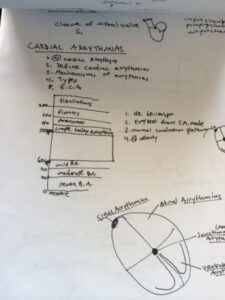
Instead of reading that the renin angiotensin aldosterone system affects blood pressure, sodium, water retention, and kidney perfusion, you sketch it out. You start with low renal perfusion. Then renin release. Then angiotensin I. Then ACE converting it to angiotensin II. Then vasoconstriction and aldosterone. Then sodium and water retention. Suddenly a paragraph becomes a process. That process becomes a picture. And that picture becomes something your brain can actually use.
This matters because nursing exams rarely reward shallow memorization. They usually test whether you understand what happens next, why it happens, and what the nurse should do about it. Drawing helps build exactly that kind of understanding.
It also slows you down in the best way. When you read fast, it is easy to fool yourself into thinking you know something because the words look familiar. But when you sit down and try to draw the concept, you find out quickly whether you really understand it. If you cannot sketch the process, there is a good chance you do not know it deeply enough yet.
That is not failure. That is feedback.
Learn more about Drawing Pictures
Drawing turns passive studying into active learning
One of the biggest mistakes nursing students make is passive studying. Highlighting, rereading, and watching lectures can all be useful, but they can also become comfortable habits that feel productive without demanding much thinking.
Drawing is active.
When you draw, you have to make choices. What is the starting point? What comes next? Which part causes the symptom? Where does the medication act? What should be a box, an arrow, a label, or a color?
Those choices force you to engage with the material.
That is why even rough, ugly, simple drawings can be incredibly effective. The value is not in making something pretty. The value is in making something meaningful to you. Your sketch of a nephron does not need to belong in an art gallery. It just needs to help you remember where filtration happens, where reabsorption occurs, and how diuretics affect the process.
The act of creating the visual is what strengthens learning.
You do not need artistic talent to use this method
This is the part a lot of students need to hear.
You do not have to be good at drawing.
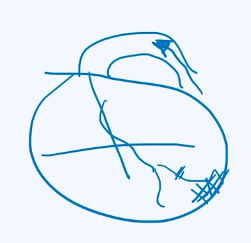
You need circles, arrows, labels, boxes, and maybe a few stick figures. That is it. A heart can be a rough outline. A blood vessel can be a tube. A cell can be a blob with labeled parts. A medication pathway can be boxes connected by arrows.
Your goal is not realism. Your goal is clarity.
In fact, simpler is usually better. When your pictures are too detailed, they become harder to review and harder to recreate from memory. Nursing school visuals work best when they strip the topic down to the essentials.
Think about it like this. If you can draw a concept simply, that usually means you understand the main idea. If your drawing gets too cluttered, it may be a sign that you are trying to hold too many disconnected facts at once.
Keep asking yourself, what is the simplest version of this concept that still makes it accurate?
That question alone can make you a better student.
Start with topics that are already hard to understand
If you want to start using drawing today, do not begin with the easiest chapter. Start with something that feels confusing.
That is where the payoff is biggest.
Great topics for drawing include:
Pathophysiology processes like heart failure, shock, sepsis, or diabetic ketoacidosis
Medication mechanisms like how ACE inhibitors, beta blockers, insulin, or diuretics work
Anatomy and physiology topics like the cardiac cycle, nephron function, gas exchange, or the action potential
Lab value interpretation and clinical reasoning, such as what happens when potassium rises or when oxygenation drops
Nursing interventions, especially for priority questions and clinical scenarios
These are all topics where understanding the sequence matters more than just memorizing definitions. Drawing helps you map the sequence.
For example, instead of memorizing that left sided heart failure causes pulmonary congestion, draw it. Show poor left ventricular pumping. Show blood backing up into the lungs. Show fluid leaking into alveoli. Show shortness of breath and crackles. Once you see the path, the symptoms make sense. And when symptoms make sense, exam questions become easier to answer.
Use color to make details easier to retrieve
Color is not just decoration. It can be a retrieval cue.
When used well, color helps separate ideas and makes review faster. You might use red for oxygenated blood, blue for deoxygenated blood, green for medications, yellow for hormones, and purple for signs and symptoms. Or you may create your own system based on what feels natural to you.
The key is consistency.
If every drawing uses random colors with no purpose, the color will not help much. But if you always color compensatory mechanisms one way and disease effects another way, your brain starts to recognize those patterns quickly.
This is especially helpful for topics that involve multiple moving parts. Think endocrine pathways, acid base balance, electrolyte disorders, or cardiac conduction. Color helps reduce visual overload and makes it easier to find the main point at a glance.
Do not overcomplicate it. A cheap set of colored pencils or pens is enough. You are not building a masterpiece. You are building memory hooks.
Mind maps are perfect for connected nursing concepts
Some nursing topics are not linear. They branch.
That is where mind maps shine.
A mind map starts with one central concept in the middle of the page. Then you build branches outward. Each branch represents a related piece of the topic. This works really well for disorders, medications, and clinical reasoning.
Take heart failure as an example. In the center, write heart failure. One branch can be causes. Another can be symptoms. Another can be diagnostics. Another can be medications. Another can be nursing interventions. Another can be complications. Another can be patient teaching.
Now the topic stops feeling like a wall of information and starts feeling organized.
Mind maps are also great for comparing similar concepts. You can create branches for hyperkalemia versus hypokalemia, respiratory acidosis versus respiratory alkalosis, or Crohn disease versus ulcerative colitis. These comparisons are exactly the kind of thing nursing exams love to test.
You can do mind maps on paper, in a presentation app, or with digital diagram tools. The platform matters less than the thinking.
Drawing helps with NCLEX style thinking too
This method is not just for science classes. It also helps with NCLEX style questions because NCLEX is built on connection and prioritization.
When you draw, you start noticing cause and effect. You start noticing which sign matters first. You start noticing what intervention changes the outcome. That is the same thinking you need for application questions.
For example, if you draw the progression of hypoxia, you can connect decreased oxygenation to restlessness, tachycardia, increased work of breathing, confusion, and eventual decline. Once you understand the progression visually, you are much more likely to recognize early warning signs in a question stem and choose the right nursing action.
This is one of the biggest advantages of visual learning in nursing. It helps move knowledge out of the textbook and into clinical reasoning.
That is the whole goal.
A simple way to use drawing in your next study session
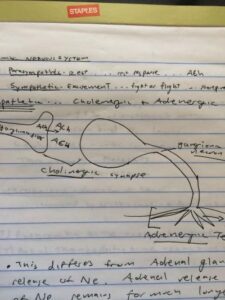 Here is a practical approach you can start using right away.
First, pick one concept from class that feels heavy or confusing.
Second, read or review it just enough to identify the main points. Do not try to copy the whole textbook.
Third, close the book and sketch the concept from memory. Use arrows, labels, color, and short notes.
Fourth, reopen your material and compare your drawing to the source. Fix what is missing or inaccurate.
Fifth, redraw it more simply if needed.
That last step matters. The second version is often much stronger because you have already worked through the confusion once.
You can also build a notebook of these visuals over time. That notebook becomes a powerful review tool before exams because it contains the concepts you had to wrestle with, not just the ones that came easy.
Common mistakes to avoid
The biggest mistake is waiting until you understand everything perfectly before trying to draw.
Do not wait.
Drawing is part of how you get to understanding. Start messy. Start incomplete. Start with what you know and fill in the rest.
Another mistake is copying diagrams without thinking. If you are just reproducing someone else’s chart exactly, you may not be processing the concept. Try to put it in your own format and your own words.
A third mistake is making visuals too crowded. If your page looks overwhelming, break the topic into smaller chunks. One drawing for disease process. One for signs and symptoms. One for medications. One for nursing care.
And finally, do not compare your notes to someone else’s notes. Your visuals need to make sense to you. That is what makes them useful.
The deeper reason this method works
At the end of the day, drawing works because it helps you translate information.
You are taking abstract words and turning them into a structure your brain can hold onto. You are converting complexity into meaning. That is a huge advantage in nursing school, where students are constantly expected to learn difficult material quickly and use it under pressure.
When you draw a concept, you are not just reviewing it. You are rebuilding it.
That rebuilding process is where learning gets stronger.
So if you have been stuck rereading chapters and feeling frustrated that nothing is sticking, this may be the shift you need. Grab paper. Grab pens. Pick one hard topic. Draw it badly if you have to. Use arrows. Use color. Use boxes. Use labels. Build a mind map. Break down the process.
Do it again tomorrow with another topic.
Over time, you will notice something important. You are not just memorizing more. You are understanding more. And in nursing school, that changes everything.