You have probably heard that your heart is a pump, but what happens when a pump has no power to make it run?
I want to share with you a story about a patient who had trouble with their pump. The issue was not with the heart itself, but with the blood flow that provides oxygen to the heart. When there is disruption in blood flow to the heart muscle, it will shut down and this is what we call heart failure.
Meet Nurse Abby
Hi, my name is Abby!

I am an RN and I love The cardiac ICU – it is my favorite unit to work in.
My nursing school education was a success due to nursing.com/, and now I am proud to be part of the team!
My nursing career includes experience in Med-Surg, Critical Care Nursing in the Cardiovascular ICU, a Cancer Hospital ICU, and a Chemotherapy Infusion Clinic.
The heart is just amazing in all that it does, but it’s complex, which can make it tricky to learn everything you need to know. But not impossible! If you need some help you can find it at nursing.com/heart.
So let me tell you about this patient of mine. They had just come out of heart surgery for what is referred to as the ROSS Procedure. Part of this procedure requires the surgeon to reattach the coronary arteries to the aorta. While reattaching them, they were accidentally sutured closed. Post-procedure, the heart itself was fine, I mean, blood flow through it was unobstructed and the valves, including the newly grafted aortic valve, all seemed to be working great. But oxygenated blood going to the heart’s myocardium, to provide its power, had been blocked.
What do you think would happen to a patient that has blocked coronary arteries? I put a link in the description below for a quick practice quiz you can take that is related to this topic. See what your current level of understanding is. Click below to try it!
Go ahead, I’ll wait . . . just click here.
How did you do?
Now back to the story…
As soon as the patient was rolled into post-op, as you can imagine, they immediately went into Heart Failure. The power to the pump had been shut off! So, it stopped working. There was inadequate blood supply to power the heart. They had to be put on an RVAD and LVAD – or Right and Left Ventricular Assistive Devices to help take the place of the failed pump’s function of powering circulation.
After months of this, we were finally able to get a heart transplant and the patient was able to recover!
Heart Failure Pathophysiology
Left-Sided Heart Failure:
-
- Cause: Typically arises from conditions such as coronary artery disease, hypertension, or myocardial infarction.
- Pathophysiology:
- Systolic Dysfunction: The left ventricle fails to contract forcefully during systole, reducing the amount of blood ejected into the systemic circulation.
- Diastolic Dysfunction: The left ventricle fails to relax adequately during diastole, impairing its ability to fill with blood.
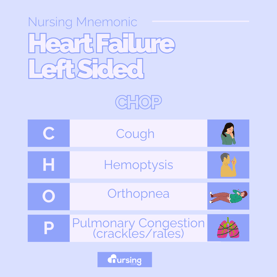
- Consequences: Decreased cardiac output leads to inadequate oxygen delivery to systemic tissues and organs, resulting in fatigue, dyspnea, confusion and impaired exercise tolerance.
Right-Sided Heart Failure:
-
- Cause: Often secondary to left-sided heart failure, chronic lung diseases (such as COPD), or conditions affecting the right ventricle directly.
- Pathophysiology:
- Impaired Right Ventricular Function: Inability of the right ventricle to effectively pump blood into the pulmonary circulation.
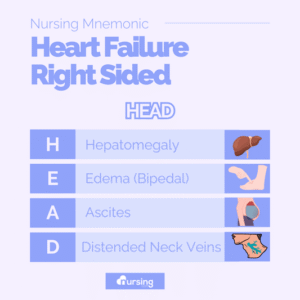
- Consequences: Backflow of blood into the systemic venous circulation, leading to systemic congestion, peripheral edema, JVD, and hepatomegaly.
Heart Failure Signs and Symptoms:
- Shortness of Breath (Dyspnea):
- Patients may experience difficulty breathing during activity or while resting, particularly when lying flat (orthopnea). They might need to prop themselves up with extra pillows to breathe easier.
- Fatigue and Weakness:
- Feeling unusually tired or weak during everyday activities due to insufficient blood flow and oxygen to muscles.
- Swelling (Edema):
- Fluid buildup can cause swelling in the legs, ankles, feet, or abdomen, leading to weight gain and bloating.
Diagnostic Tests for Heart Failure:
- Echocardiogram (Echo):
- Think of this as a special camera that uses sound waves to take pictures of your heart in action. It shows doctors how your heart moves and pumps blood. They can look at the size and shape of the heart and its parts, like the chambers and valves. It also helps them figure out the ejection fraction, which is a number that tells them how much blood the left ventricle pumps with each beat.
- Electrocardiogram (EKG or ECG):
- This test checks the heart’s electrical activity to see how effectively electrical conduction is taking place with each heartbeat. Sticky pads called electrodes are placed on your skin, and they pick up the electrical signals that make your heart beat. This test can show if the heart’s rhythm is normal or irregular, if the heart is enlarged, and if there’s been any heart attack or damage to the heart in the past.
- Blood tests:
- Natriuretic peptides (BNP or NT-proBNP): These are special proteins that the heart releases when it’s working too hard. If someone has a lot of these proteins in their blood, it might indicate heart failure.
- Doctors also use other blood tests to check on different things that might affect the heart or be affected by heart failure, like the kidneys, liver, thyroid, the number of blood cells, and fats in the blood.
I stressed about passing my class and ultimately passing the NCLEX.
I found success when I started using nursing.com/ because it helped me find the must-know information with clear and concise videos, and then I would check my knowledge with the lesson quizzes.
The huge difference in symptoms between right- and left-sided heart failure became clear, and I could picture what was going on!
I used the SIMCLEX to not only evaluate if I was ready for the NCLEX, but it would also give me personalized suggestions on what I should study to fill in my knowledge gaps.
I could focus on those topics further with custom quizzes as well as using the additional study tools that are adapted to my personal learning style.

If you are still looking for those moments where everything clicks and you start to think like a nurse. . . what worked for me was nursing.com/ – and for more resources specifically on the heart, you can go to nursing.com/heart.
Now, to help build your heart failure knowledge and start piecing together the beginnings of a heart failure care plan.
Heart Failure Care Plan
Heart failure is a common condition you will deal with working as an RN. Let me share part of my care plan with you, that I would use to help a patient with Heart Failure.
Let’s start with the desired outcomes for the patient
Desired Outcomes for Heart Failure Nursing Care:
- Optimized Cardiac Function
- Fluid Balance Maintenance
- Symptom Relief
- Medication Adherence
- Lifestyle Modification
Subjective Data:
- Difficulty breathing
- Heart palpitations or feeling like the heart is racing
- Weakness
- Fatigue
- Reports significant weight gain or loss
Objective Data:
- Peripheral edema
- JVD
- Crackles in the lung bases
- Coughing
- Pink, frothy sputum
- SOB with exertion
- ↓ SpO2
- Tachycardia
- Possible Atrial Fibrillation on ECG
- ↓ LOC
- Signs of decreased perfusion
- ↓ pulses
- Cool, clammy skin
- Diaphoretic
- Slow capillary refill
- Possible cyanosis or dusky skin
Nursing Assessment for Congestive Heart Failure:
- Health History:
- Current Symptoms: Document the presence and severity of symptoms such as dyspnea, fatigue, orthopnea, paroxysmal nocturnal dyspnea, and peripheral edema.
- Medical History: Obtain information on prior cardiac events, hypertension, diabetes, and any other chronic conditions affecting cardiac function.
- Medication History: Review the patient’s current medications, noting compliance, and potential side effects.
- Physical Examination:
- Vital Signs: Monitor blood pressure, heart rate, respiratory rate, and temperature. Note any signs of tachycardia, hypertension, or hypotension.
- Cardiovascular Examination: Assess for abnormal heart sounds (e.g., S3 gallop), jugular venous distension, and peripheral edema.
- Respiratory Examination: Auscultate lung sounds for crackles or wheezing, and assess respiratory effort.
- Fluid Balance Assessment:
- Daily Weights: Implement a daily weight monitoring system to detect fluid retention.
- Edema Assessment: Evaluate for peripheral edema, noting location, pitting, and degree.

- Nutritional Assessment:
- Dietary Habits: Assess the patient’s dietary habits, particularly sodium and fluid intake. Collaborate with a dietitian to develop a heart-healthy diet plan.
- Weight Changes: Monitor for unintended weight gain or loss.
- Medication Adherence:
- Review Medications: Verify the patient’s understanding and adherence to prescribed medications.
- Side Effects: Assess for any medication side effects, especially those related to diuretics or changes in blood pressure.
- Psychosocial Assessment:
- Emotional Well-being: Evaluate the patient’s emotional state, addressing potential anxiety or depression related to the chronic nature of CHF.
- Support System: Identify available support from family and friends.
Nursing Interventions and Rationales for Heart Failure
.png?width=2240&height=800&name=Copy%20of%20Header%20Banner%20for%20Blog%20(2).png)
Evaluation for Congestive Heart Failure Nursing Care:
The entire Heart Failure Care Plan, along with 230+ other care plans, are available on nursing.com/.
Looking for more? Visit nursing.com/heart now to download a Nursing cheat sheet for free.
I hope this has helped you understand heart failure a bit better so you know what to look out for.
We’re rooting for you . . . Go out and be your best self today. . .
Happy Nursing!