
Nursing school exams can feel like they were written in a different language. You study hard, you know the content, and then you sit down for the test and suddenly every question feels like a trick. And here’s the wild part: a lot of the time it is not that your instructors are trying to be evil. It is that nursing exams are designed to test judgment, safety, and priorities, not just facts.
That’s why you can read a chapter, memorize a bunch of details, and still get crushed. Nursing questions are asking, “Are you going to be a safe nurse?” They want to know if you can recognize what matters most, what to do first, and what will keep your patient alive.
So let’s break down 11 test-taking strategies you can start using immediately. These are the kinds of moves that help you stop second-guessing, stop spiraling in your head, and start answering like a nurse.
The mindset shift that changes everything
Before we jump into strategies, lock this in: nursing school tests are not typical school tests.
Most of your past exams rewarded recall. You either knew the fact or you did not. Nursing exams reward clinical reasoning. You can know a lot and still miss questions if you do not understand what the question is truly asking.
The goal is not to “outsmart” the test. The goal is to think through the scenario with a safety-first mindset and choose the most appropriate nursing action.
Now let’s get practical.
(Learn more about Test Taking Strategies)
Strategy 1: The SATA success method
Select all that apply questions can wreck your confidence fast because you do not get the comforting feeling of choosing one “best” answer. The key to SATA is to stop treating it like a multiple-choice question and start treating it like a series of true or false statements.
Here’s the method:
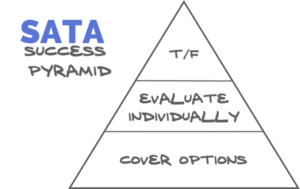
Cover the options at first.
Read the question without letting the answer choices lead you. Your brain will latch onto familiar words and you will start building a story that may not match the question.-
Evaluate each option individually.
Do not group answers together. Do not say, “A and B seem similar so both must be right.” That is how you talk yourself into confusion. -
Turn each option into true or false.
Ask yourself, “Is this statement true in general?” If it is true, select it. If it is false, move on. Treat each option like it stands alone.
What this does is keep you out of the mental trap where you start comparing options to each other instead of comparing each option to nursing reality.
(Learn more about SATA Questions)
Strategy 2: Absolute words are red flags
Words like always, never, all, none, every are usually a big warning sign.
Why? Because nursing rarely deals in absolutes. Patients are different. Settings are different. Conditions change. The safest nurse is the one who thinks critically, not the one who assumes “always.”
Two exceptions where an absolute statement might be correct:
-
Safety rules that are consistently true
-
Rules that apply across the lifespan and across settings
A classic example is something like keeping a urinary drainage bag below the bladder level. That’s a safety and infection prevention issue and it applies broadly.
So your move is simple: when you see absolute language, pause and ask, “Is this truly always true?” If not, eliminate it.
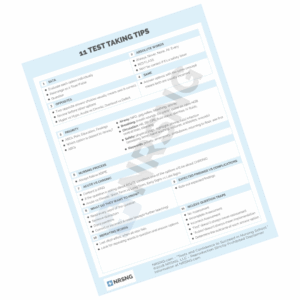
Download the 11 Test Taking Cheatsheet
Strategy 3: Opposites are a clue
When you see two options that are opposites, one of them is often correct.
Examples:
-
hyperkalemia vs hypokalemia
-
fluid overload vs fluid deficit
-
acute vs chronic
-
increased vs decreased
This is not magic. It is just a common test design pattern. Writers will often include opposing choices to test whether you understand directionality.
Your job is to evaluate those opposite options first, using the clinical picture. If the stem screams dehydration, you should be leaning toward deficit, not overload.
Strategy 4: “Same answer” means both are probably wrong

Sometimes two answer options are basically saying the same thing in different words. When that happens, your brain wants to pick one of them because it feels familiar and correct.
But here’s the test logic: if two options are essentially identical, they cannot both be the single best answer. That usually means the test is baiting you.
So if you spot “same answer,” eliminate them and move on. You just improved your odds immediately.
(Learn more about Same Answers)
Strategy 5: Master priorities with ABCs plus DEF
Priority questions are everywhere in nursing school and on the NCLEX style exam. You can know the content and still miss these if you do not have a priority framework.
A clean framework is ABCs plus DEF:
-
A: Airway
-
B: Breathing
-
C: Circulation
-
s: Safety
Plus:
-
D: Discomfort
-
E: Education
-
F: Feelings
Here’s what this means in real life test thinking:
If your patient has a compromised airway, nothing else matters. Not teaching. Not emotional support. Not even pain control. You handle airway and breathing first because without oxygen, you do not have a patient.
Then circulation issues. Then safety. After the life threats are handled, you can move to discomfort, then education, then feelings.
This framework also helps you stop getting tricked by compassionate-sounding answers. Nursing exams love to include answers about teaching and reassurance because they sound “nice.” But nice is not always priority.
(Learn more about Priorities in NCLEX Questions)
Strategy 6: Do what you can before calling the provider
Nursing exams love the option “notify the provider.” And students pick it because it feels serious.
But in real nursing, calling the provider can take time. Your job is to stabilize the patient and act within your scope before you leave the room.
So ask yourself:
-
Is there an immediate intervention I can do right now as the nurse?
Raise HOB, apply oxygen, check vitals, verify a blood glucose, ensure safety, give a scheduled med, start prescribed protocol, reposition, etc.
If you can fix or stabilize something safely within your scope, do that first. Then call the provider if needed.
This one principle alone will save you on a lot of “what do you do first” questions.
Strategy 7: Never break the nursing process
The nursing process is more than a poster on the wall. It is a test-taking weapon.
Use ADPIE:
-
Assess
-
Diagnose
-
Plan
-
Implement
-
Evaluate
On most questions, the biggest trap is choosing an intervention before you have assessed.
If the question stem gives you incomplete data, your first move is usually to assess or gather more information. You cannot plan or implement safely if you do not know what is happening.
But also remember this: if the question clearly shows that assessment has already been completed, do not keep assessing just because “assessment is always first.” Move to the next appropriate step.
(Learn more about the Nursing Process in Nursing Questions)
Strategy 8: Answer what they are actually asking
 A lot of students miss questions because they answer the question they wish they were asked.
Slow down and identify the key words:
-
“First”
-
“Best”
-
“Most important”
-
“Priority”
-
“Further teaching is needed”
-
“Except”
-
“Which statement indicates understanding”
Then restate it in your own words, like:
-
“They want the immediate action.”
-
“They want the unsafe option.”
-
“They want what shows the patient does not get it.”
This keeps you from chasing distractors.
Strategy 9: Remove obvious distractors fast
Some answer choices are just nonsense. They do not match the condition, they do not match safety, or they are clearly outside nursing scope in the scenario.
Eliminate those quickly so you can focus on the real contenders.
This is also where a lot of confidence comes from. When you can cut a four-option question down to two, your brain calms down.
Strategy 10: Simplify back to basic anatomy and physiology
When you are stuck, you are usually stuck because you are trying to remember a detail you do not fully own.
So go backwards. Strip it down to what the body is doing.
-
If it is hepatitis, think liver function.
-
If it is heart failure, think pump problem leading to congestion.
-
If it is COPD, think chronic air trapping and gas exchange issues.
-
If it is renal failure, think fluid and electrolyte regulation.
Nursing exams reward foundational understanding. If you can reason from A and P, you can often pick the safest answer even when your memory feels fuzzy.
Strategy 11: Know the classic question traps
Test writers use patterns. You can learn to spot them.
Here are the big ones:
Trap 1: No assessment has been done
If you do not have enough data, you cannot safely intervene. So you assess first.
Trap 2: Incomplete assessment
Maybe some data is present, but not enough to justify the intervention in the answer choice.
Example: Diabetic patient shaking. A flashy option is to give IV dextrose immediately. But you do not even know the glucose yet. The safer move is to check blood sugar first, then intervene based on results and patient presentation.
Trap 3: “First” does not always mean “assessment”
This is subtle. Sometimes the first action is an assessment action. Checking a blood glucose is an action, but it is also assessment. So do not get hung up on wording. Think nursing process and safety.
Trap 4: Determine the outcome of each answer
This is one of the most powerful ways to test your choice.
Ask: “If I do this and then I walk out of the room, is the patient going to be okay?”
If the answer is no, it is probably not the correct priority action.
This pushes you toward safety and away from answers that sound good but leave the patient unstable.
(Learn more about Question Traps)
Putting it all together: how to practice this before your next exam
Reading strategies is helpful, but you lock this in by practicing the thinking.
Try this routine for your next set of practice questions:
-
Do 20 to 30 questions in one sitting.
-
For every missed question, label why you missed it:
-
Did not read the question
-
Fell for absolute word
-
Forgot priority framework
-
Implemented before assessing
-
Overthought and changed answer
-
-
Write one sentence about what you will do differently next time.
This is how you turn test-taking into a skill, not a mystery.
Download the 11 Test Taking Cheatsheet
Final encouragement for the student who feels behind
If you have been struggling, it does not mean you are not smart. It usually means no one taught you how to take nursing exams.
The “four-minute mile” lesson applies here: once you see that it can be done, it becomes more doable for you too. Nursing school is hard, but it is learnable. And test-taking is trainable.
Keep focusing on safety, priorities, and the nursing process. Know your content, yes. But also learn how the test thinks. That combination is where your scores start to climb.