Jon Haws, BS, BSN, RN, Alumnus CCRN
Jon Haws, RN is a nurse, educator, and founder of NURSING.com, dedicated to making nursing education easier and more effective. After facing burnout himself, he built NURSING.com to help students pass the NCLEX® with confidence and thrive in their careers.
Note: In this post I reference some foundational books that have transformed the way I think about education and learning differences. I highly recommend checking one or two of them out. Click below to view them on Amazon.
They told me I couldn't be a nurse because of my anxiety. They were wrong. And if you've been told you can't be a nurse because of your ADHD, dyslexia, or anxiety – they're wrong about you too.
I've only publicly shared this a couple of times before, but during nursing school, my anxiety became so crippling that I withdrew before my final semester.
Yes, you read that right.
I didn't just struggle – I completely walked away, taking an entire YEAR off before finding the courage to return and finish my degree.

During those darkest days, I would wake up with my heart already racing, a crushing weight on my chest, and a constant sense of impending doom surrounding my education. Sometimes I'd be physically ill before even reaching the hospital for clinicals.
The shame I felt only compounded the problem – "real nurses don't get scared," I told myself. "Maybe I'm not cut out for this."
When I finally withdrew, I felt like an absolute failure. What I didn't realize then was that my struggles with anxiety weren't weakness – they were developing unique strengths I would later use to save lives.
I'm telling you this deeply personal story for one reason:

Nursing education is stuck in the 1950s. While medicine advances at lightning speed, the way we teach nursing remains shockingly outdated – privileging one narrow learning style while marginalizing the very cognitive differences that can make exceptional nurses.
There's a silent bias in nursing education that nobody wants to talk about. While we pride ourselves on diversity in other areas, cognitive diversity remains stigmatized.
How many brilliant potential nurses have we lost because the system wasn't designed for their minds?
Our YouTube survey revealed a staggering truth: 40% of nursing students with learning differences feel that nursing school is "impossible sometimes" for people with ADHD, anxiety, dyslexia, and other differences. Another 22% report they "have to fight harder than others" to succeed. That's nearly 70% of students feeling the system isn't designed for their brains.
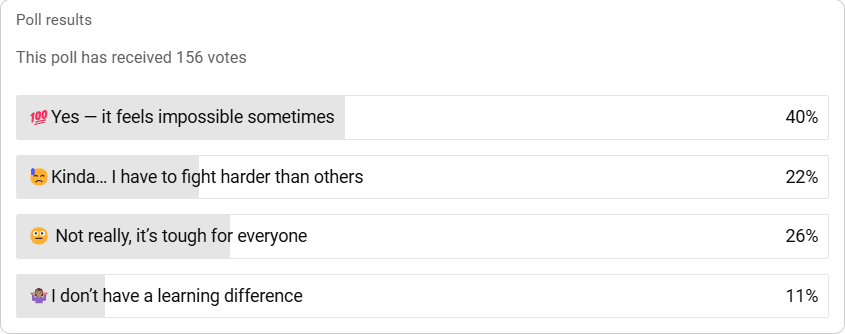
Our NURSING.com survey data reveals just how common learning differences are among nursing students:
When we dig deeper into the numbers, we found that 51.6% of our users report having at least one learning difference, with 18% reporting multiple learning differences. This isn't a small minority – it's the majority of future nurses bringing different cognitive strengths to healthcare.
When we look at learning styles, only 4.2% of learners are primarily text-based learners. Yet nursing school remains overwhelmingly focused on text-heavy learning methods with:
Let's challenge conventional wisdom head-on: Your learning difference isn't a barrier to becoming a nurse – it's your secret weapon.
The question isn't whether you can become a nurse with ADHD, dyslexia, or anxiety. The real question is whether healthcare can afford to lose your unique perspective and abilities.
In "What Your ADHD Child Wishes You Knew," Sharon Saline explains that ADHD minds often possess "an uncanny ability to hyperfocus in crisis situations" and "exceptional creativity when solving complex problems." These aren't compensatory skills – they're intrinsic strengths of the ADHD brain that can be tremendous assets in healthcare settings.
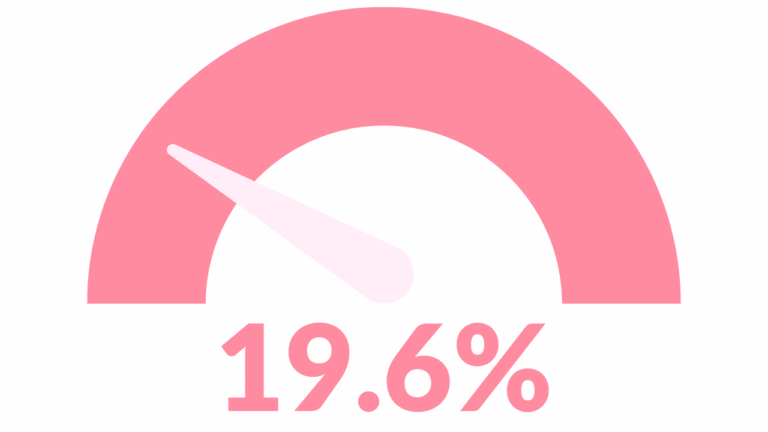
Our survey data shows that 19.6% of NURSING.com users have ADHD – nearly one in five future nurses bring these unique cognitive strengths to patient care. This statistic aligns with research showing that people with ADHD are often drawn to people-oriented careers with higher practical components.
As one of our students with ADHD wrote, "In nursing school, ADHD can be a struggle. But on the floor, when everything is happening at once, I become centered in a way my neurotypical colleagues don't understand. It's like my brain was built for healthcare chaos."
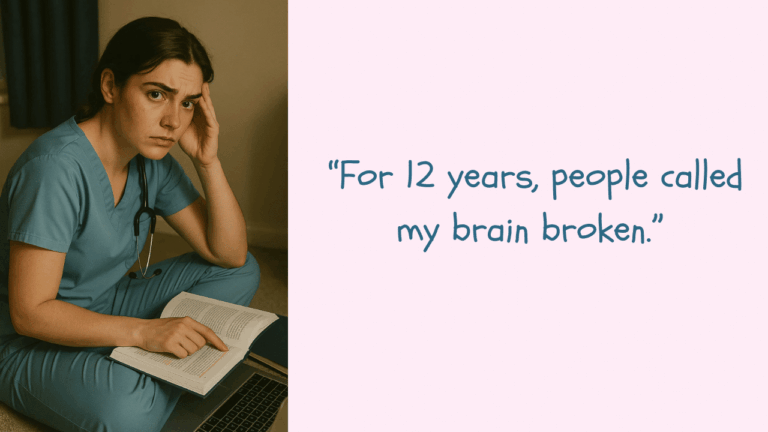
One ER nurse with ADHD told me: "For 12 years, people called my brain 'broken.' Then I found nursing, where suddenly my ability to track multiple patients while remaining alert to subtle changes became my superpower. In emergencies, when everyone else freezes, my brain finds perfect clarity. What was once my greatest shame is now my greatest strength."
Your ADHD mind gives you:
As David Shenk writes in "The Genius in All of Us," what we perceive as limitations often contain hidden potential: "Talent is not the cause but the result of something... It's not inherited but developed through a combination of opportunities, motivation, training, and support." The unique challenges of the ADHD brain often drive the development of exceptional compensatory skills – organized systems and double-check routines that enhance patient safety.
When I talk with seasoned nurses who have ADHD, they consistently describe moments of almost supernatural clarity during emergencies – what others experience as overwhelming, they experience as perfectly aligned with their brain's natural processing style. As one put it: "My whole life I was told to 'calm down' and 'focus,' but in the trauma bay, my 'too much' is exactly enough."
"The Power of Different" highlights research showing that dyslexic individuals often excel at identifying patterns and making novel connections between ideas – critical skills in complex medical situations. Saltz notes that many successful people with dyslexia report that "their ability to think differently was key to their success."
In "Learning Outside the Lines," Jonathan Mooney and David Cole argue that dyslexic minds are often better at seeing "the big picture" while neurotypical minds may get lost in details. This holistic perspective is invaluable in nursing, where understanding the interconnectedness of multiple body systems is essential for effective care.
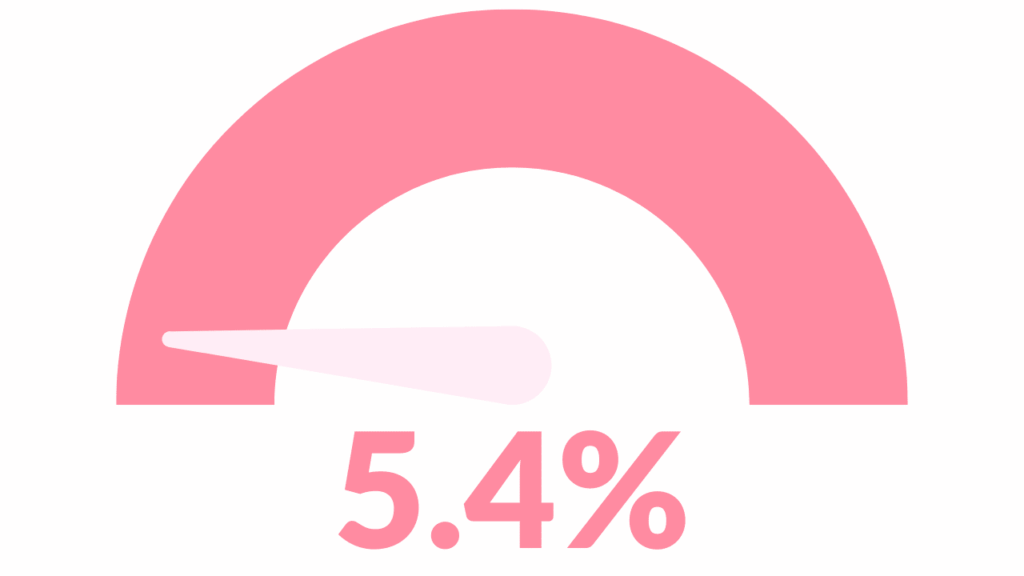
Our survey data reveals that 5.4% of NURSING.com users have dyslexia – representing thousands of future nurses with these unique cognitive strengths.
One dyslexic ICU nurse shared: "When we get complex patients with multiple interacting problems, I can visualize the relationships between systems in a way my colleagues can't. My brain naturally makes connections that others have to consciously work to see."
Another nursing student with dyslexia told us: "Reading drug names is still challenging for me, so I've developed this elaborate visual memory system. I actually remember medication interactions better than my classmates because I've had to create these vivid mental images of how they connect."
Your dyslexic mind gives you:
Research increasingly supports what many dyslexic nurses have intuitively known – their different cognitive wiring often provides unique insights into patient care that can be lifesaving. As Mooney and Cole explain: "It's not that dyslexic people can't read – it's that they read differently. And that different perspective extends to how they process all kinds of information."
Many of our users with dyslexia report developing compensatory systems that eventually become advantages. One wrote: "I've created these elaborate color-coding systems for my clinical notes because of my dyslexia. Now my preceptor is asking me to teach my system to other students because it's so effective."
Pass Your Tests,
Improve Your Grades
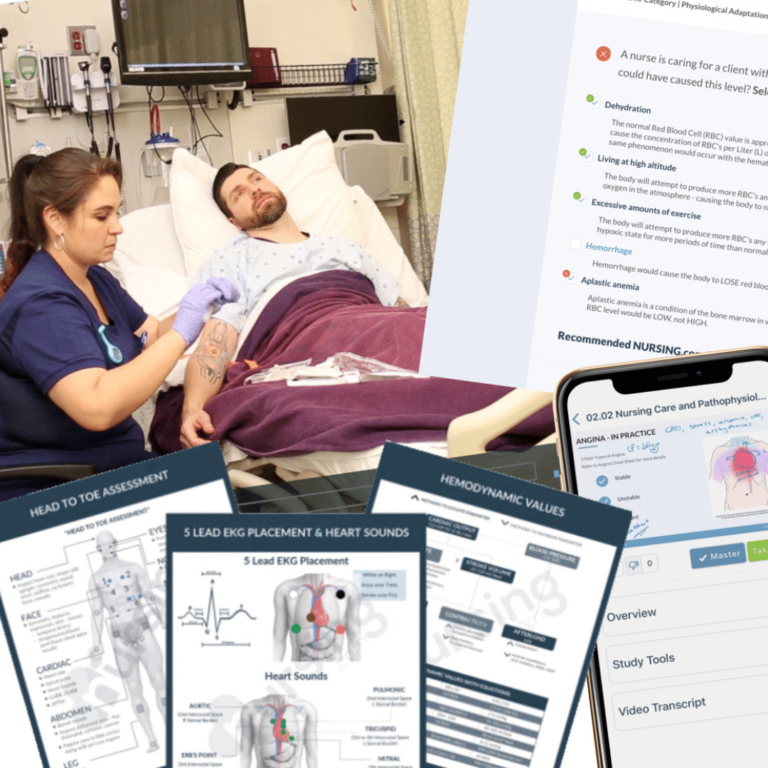
Enter a nursing topic and view videos and cheatsheet instantly
Perhaps the most misunderstood learning difference is anxiety. Far from being merely a hindrance, controlled anxiety can be the foundation of exceptional nursing care.
In "The Power of Different," Saltz explains that anxiety often correlates with higher conscientiousness and attention to detail – qualities directly applicable to patient safety in nursing. The vigilance that comes with anxiety – the heightened awareness, the careful attention to detail, the thorough preparation – these are qualities that directly translate to preventing medical errors.
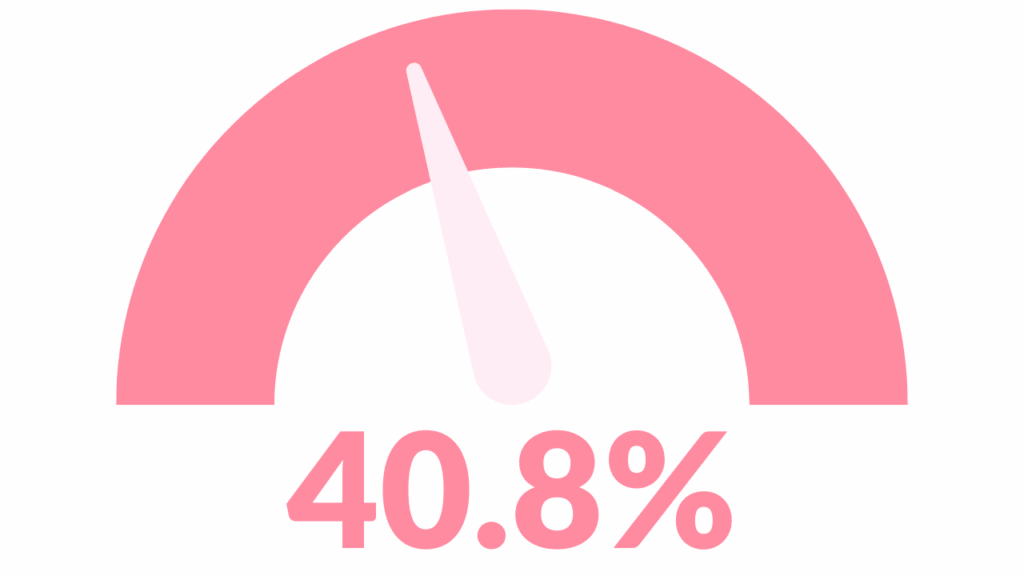
Our survey data shows a remarkable 40.8% of NURSING.com users experience anxiety – over two in five future nurses bring this heightened awareness to patient care. This aligns with the high-stakes nature of healthcare and the type of conscientious individuals who are drawn to nursing.
A cardiac nurse who manages anxiety told me: "My colleagues joke that I have a sixth sense for when patients are about to crash. What they don't realize is that my anxiety has trained me to notice subtle changes others miss. The same hypervigilance that exhausts me in my personal life has saved countless lives on my unit."
Another nursing student shared: "My anxiety makes me triple-check everything. I used to be embarrassed about it, but my clinical instructor told me she wishes all students were this thorough with medication administration."
Your experience with anxiety gives you:
As one of our graduates with anxiety explained: "I can instantly recognize the look of fear in my patients' eyes because I know exactly what anxiety feels like. I can validate their feelings and provide comfort in ways some of my colleagues struggle to understand."
Free e-Book
77 Must-Know NCLEX Topics

About NURSING.com
The leading platform for nursing education and NCLEX® prep. Recognized as a top innovator in nursing education, where over 1,000,000+ nursing students gain confidence, improve their grades, and pass the NCLEX®.
Creators of SIMCLEX®, the world's most advanced NCLEX® simulation exam.
Our mission? To end the nursing education struggle and help students become confident, competent nurses.
Pass Your Tests,
Improve Your Grades
Enter a nursing topic and view videos and cheatsheet instantly
What topic are you struggling with?
Take a practice quiz
Let me share more about my own experience with anxiety during nursing school, because I want you to understand that I truly get it.
During my worst moments, my anxiety became completely paralyzing. I remember one clinical day where I was assigned to give my first injection. My hands were shaking so badly that I couldn't even draw up the medication. My instructor had to take me aside, and I broke down in tears, convinced I was going to harm my patient or be kicked out of the program – or both.
The physical symptoms were overwhelming – racing heart, sweaty palms, nausea, insomnia before clinical days. But worst of all was the mental torture – the constant voice telling me I was a fraud, that I would never be good enough, that I was going to make a fatal mistake.
When I finally made the decision to withdraw, it felt like both relief and devastation. Relief from the immediate pressure, but devastation at what I perceived as my personal failure. I told almost no one the real reason I left. Instead, I made up excuses about "needing time" or "family issues."
That year away from nursing school was transformative. I started therapy. I learned breathing techniques and mindfulness practices. I began to understand that my anxiety wasn't a character flaw – it was a neurological difference that, with the right tools, could be managed.
When I returned to finish my degree, I still experienced anxiety, but I had developed strategies to work with it rather than against it. I prepared meticulously. I practiced procedures until they became automatic. I used visualization techniques before entering patient rooms.
After graduation, something remarkable happened. In crisis situations, when other new nurses would freeze or panic, I found a strange sense of calm. All that preparation, all that anticipating of worst-case scenarios – it became my professional superpower. My anxiety had taught me to prepare for anything, to notice subtle changes in patients, to triple-check everything.
I share this not to suggest that anxiety is easy to manage – it's not. But to show you that what feels like your greatest weakness right now might actually contain the seeds of your greatest nursing strengths.
I won't sugarcoat it – nursing school with learning differences presents unique challenges. Traditional nursing education methods often directly clash with these learning differences.
Our YouTube survey revealed that 45% of students with learning differences feel nursing school is "impossible sometimes" for people with these differences. This isn't just perception – it's the lived reality of thousands of students fighting against an educational system that wasn't designed for how they learn.
Our analysis found that to read a Med-Surg textbook cover-to-cover during a semester, an average reader would need to read 41 hours per week – a nearly impossible task even for neurotypical students, let alone those with processing differences.
For students with ADHD, the endless lectures can feel like torture. For students with anxiety, the high-stakes nature of nursing education creates a perfect storm of triggers.A student with dyslexia shared with us: "I nearly quit in my first semester because I couldn't keep up with the reading. It wasn't that I didn't want to learn – my brain just couldn't process the information that way. I felt like I was drowning in text."

Mooney and Cole in "Learning Outside the Lines" explain that educational challenges often stem not from inherent deficits but from "a mismatch between how you learn and how you are being taught." This mismatch is particularly pronounced in nursing education, which often relies heavily on passive learning methods (lectures and reading) rather than the active, experiential learning that benefits most students – especially those with learning differences.
In our surveys, students with learning differences consistently report that clinical practice – where they can engage multiple senses and apply knowledge directly – is where they excel, while the classroom environment presents the greatest barriers.
Some specific challenges our NURSING.com users report:
For ADHD students:
For dyslexic students:
For students with anxiety:
These challenges are real. But they do not define your potential.
After working with thousands of nursing students with learning differences, I've developed a revolutionary approach that doesn't just help you survive nursing school – it helps you leverage your unique brain as an advantage.
1. Reject the Broken Brain Narrative
The first step is rejecting the harmful narrative that your brain is somehow "broken." David Shenk in "The Genius in All of Us" dismantles the myth of genetic determinism, showing that what we often think of as fixed limitations are actually dynamic possibilities: "Genes don't make unchangeable blueprints for behaviors . . . they make protein switches that are constantly turned on and off by environmental factors."
This means that your learning difference isn't a permanent limitation – it's a different pathway that, with the right approaches, can lead to exceptional abilities.
One nursing student shared: "The day I stopped apologizing for my dyslexia and started advocating for my brain's needs was the day everything changed. I stopped wasting energy hiding my struggles and started channeling that energy into finding solutions."
Another told us: "I spent years believing I wasn't smart enough because of my ADHD. In nursing school, I finally realized that I'm not less intelligent – I just process information differently. Once I embraced this, I found ways to make my 'different' brain work for me instead of against me."
2. Demand Educational Justice, Not "Accommodations"
When we call them "accommodations," we imply special treatment. Let's call them what they really are: educational justice. Legal protections under the Americans with Disabilities Act aren't charity – they're your civil rights.
In "Learning Outside the Lines," Mooney and Cole argue that what we call "accommodations" are really just "removing artificial barriers to learning" – barriers that shouldn't exist in the first place. They write: "These aren't special advantages; they're what everyone deserves: an education tailored to how they learn best."
Our survey data shows that many students still hesitate to seek the support they need – denying themselves critical resources. This isn't just a personal loss – it's a loss to the profession.
Specific educational justice measures might include:
One student told us: "Getting my official ADHD diagnosis and appropriate educational supports in my second semester wasn't 'cheating' – it was finally having a level playing field. My grades improved by almost a full letter grade because I could finally demonstrate what I actually knew."
3. Harness Your Brain's Natural Wiring
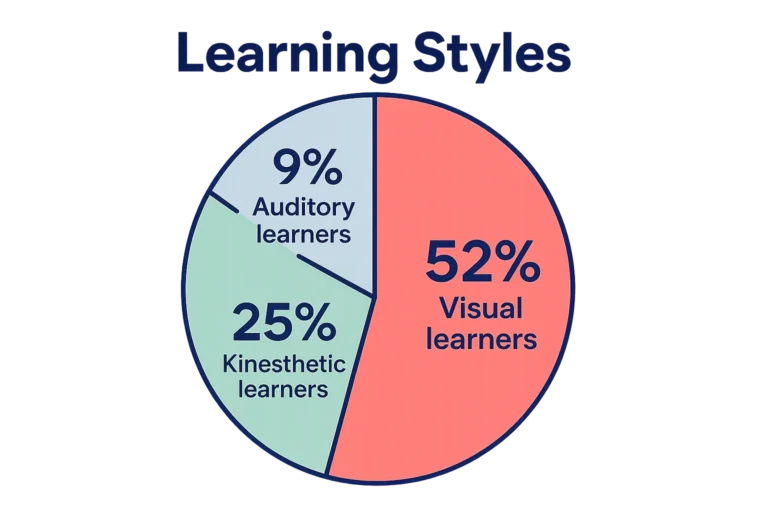
As our NURSING.com survey data shows, only about 4.2% of learners are primarily text-based, yet nursing education caters predominantly to this small minority. The distribution among nursing students shows:
Saline explains in "What Your ADHD Child Wishes You Knew" that the key is to "work with your brain, not against it." This means identifying your natural learning strengths and adapting your study approaches accordingly.
For visual learners:
For auditory learners:
For kinesthetic learners:
One dyslexic nursing student said: "I stopped fighting with textbooks and started drawing everything. I'd create elaborate diagrams connecting medications, lab values, and symptoms. Not only did I remember the information better, but I started seeing relationships between concepts that weren't obvious in the text."
4. Build Systems That Work For Your Brain
Rather than constantly fighting your brain's natural tendencies, build systems that work with them. "The Power of Different" emphasizes the importance of creating "environments that support your brain's unique processing style."
For ADHD:
For dyslexia:
For anxiety:
Mooney and Cole emphasize that these strategies aren't shortcuts or cheating – they're "strategic approaches that align your learning environment with your brain's natural strengths."
5. Find Your Tribe of "Different" Thinkers
You are not alone in this journey. Our survey data shows that 51.6% of nursing students have at least one learning difference. The stigma surrounding learning differences often isolates students, but the reality is that significant numbers of your classmates are facing similar challenges.
Connect with others who understand:
One student told us: "Finding other nursing students with ADHD transformed my experience. We understand each other's struggles without judgment, and we've created study systems that play to our strengths instead of constantly fighting our brains."
I created NURSING.com because I struggled so much as a nursing student with anxiety. I knew there had to be a better way to learn nursing – one that worked with different types of brains rather than against them.
Our platform isn't just designed to accommodate learning differences – it's built specifically to leverage the strengths that come with them. This approach aligns with what Saltz describes in "The Power of Different" as "neurodiverse-affirming environments" that don't just tolerate difference but actively value it.
Visual learning focus
Every lesson includes custom illustrations and visual note-taking – critical for the 52% of our users who are visual learners and transformative for those with dyslexia.
Concise, focused videos
Most under 10 minutes to align with natural attention spans, particularly beneficial for the 19.6% of our users with ADHD. A student with ADHD told us: "The short, focused videos were a game-changer. I could actually maintain focus throughout the entire lesson – something I never managed with hour-long lectures."
Structured learning pathways
Clear organization and prioritized content reduce the overwhelm that particularly affects the 40.8% of our users with anxiety.
Multiple learning formats
Videos, cheatsheets, practice questions, and notes allow you to engage with the same content in whatever way works best for your unique brain – essential for the 95.8% of our users who aren't primarily text-based learners.
Real-world simulation
SIMCLEX® simulates the actual NCLEX® environment, reducing test anxiety through familiarity and building confidence.
The stories of nurses who have succeeded despite – and often because of – their learning differences should inspire us all to rethink our assumptions about what makes an excellent nurse.
Elle
Diagnosed with ADHD and dyslexia, she struggled throughout traditional education but recently passed the NCLEX® and is now thriving as a nurse. She told us: "I see connections other nurses miss. My brain naturally links concepts together in ways that help me anticipate complications before they happen. What was once my greatest weakness has become my greatest strength."
Kelly
Battled severe anxiety throughout nursing school. She now excels in pediatrics, sharing: "My anxiety actually makes me more attentive to subtle changes in my pediatric patients. Parents often tell me they appreciate how thoroughly I explain everything – that's because I know exactly how it feels to be scared and confused in a medical setting."
Michael
Has dyslexia and initially failed out of his first nursing program. After being diagnosed and learning appropriate strategies, he returned to a different program and is now a successful ER nurse. He told us: "In the ER, my ability to think outside the box has saved lives. I don't process information linearly, which sometimes helps me see solutions others miss."
The healthcare challenges of tomorrow will not be solved by traditional thinking alone. We need diverse cognitive approaches to address complex problems from multiple angles.
As Shenk writes in "The Genius in All of Us," true innovation rarely comes from conventional thinking: "It is often the misfits and rebels—precisely because they think differently and are less beholden to established ways of doing things—who are most likely to come up with important new breakthroughs."
Our survey data shows that 51.6% of NURSING.com users report having at least one learning difference, with 18% reporting multiple differences. This isn't just a statistic – it's evidence that the future of nursing is being built by minds that think differently.
Your different brain isn't just capable of succeeding in nursing – it's precisely what the profession needs to evolve and improve.
Ready to try this approach yourself? Here's how to get started:
This approach builds confidence quickly because you're learning deeply rather than broadly.
I understand the struggle because I've lived it. Those dark days when I withdrew from nursing school were some of the hardest of my life. The shame, the fear, the uncertainty – I remember it all vividly.
But I also remember what happened next. I returned. I graduated. I worked in the Neuro ICU. I became a charge nurse. And eventually, I built NURSING.com to help students like us.
Your learning difference isn't a limitation – it's a different type of intelligence that the healthcare system desperately needs.
As Gale Saltz concludes in "The Power of Different": "We need to redefine what it means to be normal, not merely to be kinder to those who are different, but because people with brain differences who have struggled and developed deeper understanding are often the very people who are able to make our world better."
I'm challenging you to do more than just survive nursing school. I'm asking you to be part of a revolution that transforms nursing education and practice by embracing cognitive diversity.
Imagine a healthcare system where:
This isn't just a dream – it's already happening, one nurse at a time.
When you doubt yourself, when you're tempted to give up, remember this: The qualities that make nursing school challenging for you may be the very same qualities that will make you an exceptional, even revolutionary, nurse.
You aren't just capable of becoming a nurse. You're capable of transforming what nursing can be.
Are you ready to join the revolution?
Jon Haws, RN
Founder, NURSING.com
Jon Haws, RN, BS, BSN, alumnus CCRN, is the founder of NURSING.com, an online learning platform that has helped over 400,000 nursing students pass the NCLEX and become safe, confident nurses. He developed the SOCK Method based on his own struggles with pharmacology during nursing school.
Have you tried the SOCK method?
References and additional reading:
Discover your unique nursing school brain type
Note: In this post I reference some foundational books that have transformed the way I think about education and learning differences. I highly recommend checking one or two of them out. Click below to view them on Amazon.