

Jon Haws, BS, BSN, RN, Alumnus CCRN
Jon Haws, RN is a nurse, educator, and founder of NURSING.com, dedicated to making nursing education easier and more effective. After facing burnout himself, he built NURSING.com to help students pass the NCLEX® with confidence and thrive in their careers.
There's a moment that happens in almost every nursing student's journey. You're sitting in pathophysiology, surrounded by your classmates who seem to be nodding confidently, taking perfect notes, and asking brilliant questions.
Meanwhile, you're desperately trying to remember the difference between hyperkalemia and hypokalemia while wondering if you're the only one who feels completely lost.
That voice in your head whispers: "You don't belong here. Everyone else gets it. You're the dumbest person in this room."
If this sounds painfully familiar, I have news that might surprise you: you're not alone. Not even close.
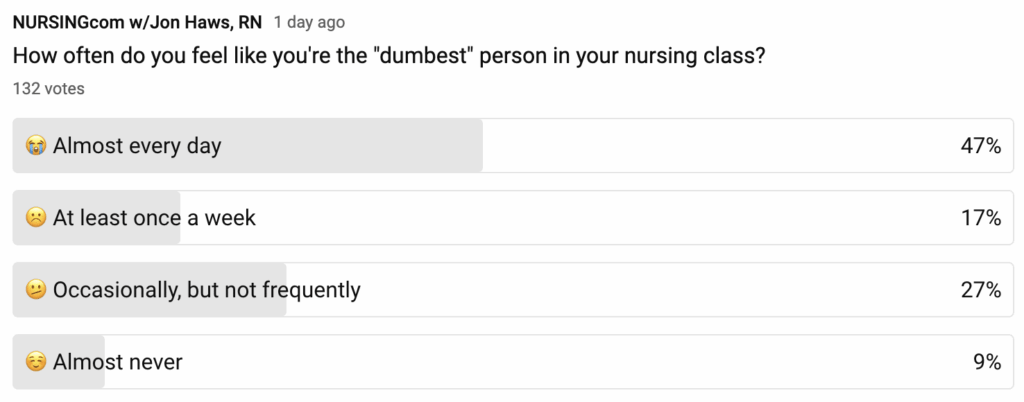
In a recent survey conducted by NURSING.com, we discovered something striking: a mere 8% of nursing students reported "almost never" feeling like the dumbest person in their class. Let that sink in. That means 92% of your classmates have felt exactly what you're feeling.
Even more revealing? 42% of nursing students admitted to feeling like the "dumbest in class" almost every day.
Every. Single. Day.
These aren't isolated feelings. Research published in the journal BMC Nursing in 2024 found that nursing students experience significantly higher levels of self-doubt compared to students in other healthcare disciplines.
The study, "Prevalence of imposter syndrome and its association with depression, stress, and anxiety among nursing students," revealed that 46.3% of nursing students experienced moderate imposter syndrome, with 33% having frequent imposter feelings and 6.2% scoring in the "intense imposter" range.
Key Takeaways:

I've been where you are. During my first semester of nursing school, I walked into a room of 25 students who would be my cohort. As I scanned the faces, a chill ran down my spine.
"I'm the only lucky one here," I thought. "Everyone else is so much more prepared. I hope no one discovers how dumb I am."
This feeling didn't go away after graduation. On my first day as a new grad nurse in the Neuro ICU of a large Trauma I hospital in Dallas, I was sweating, out of breath, and utterly convinced I'd slipped through the cracks in the hiring process. I was certain all the other new nurses had gone to better schools, done better internships, and would survive orientation when I wouldn't.

Nursing education creates the perfect storm for imposter syndrome to flourish:
Dr. Valerie Ruple, DVM, PhD, in her research on imposter syndrome among healthcare students, notes that "the psychological impact of the experiences endured while training to become a [healthcare professional] may very well be part of the reason we see such a large proportion of people in our profession affected by this syndrome."
Pass Your Tests,
Improve Your Grades
Enter a nursing topic and view videos and cheatsheet instantly
Free e-Book
77 Must-Know NCLEX Topics

About NURSING.com
The leading platform for nursing education and NCLEX® prep. Recognized as a top innovator in nursing education, where over 1,000,000+ nursing students gain confidence, improve their grades, and pass the NCLEX®.
Creators of SIMCLEX®, the world's most advanced NCLEX® simulation exam.
Our mission? To end the nursing education struggle and help students become confident, competent nurses.
Pass Your Tests,
Improve Your Grades
Enter a nursing topic and view videos and cheatsheet instantly
What topic are you struggling with?
Take a practice quiz
Here's the ultimate irony: imposter syndrome disproportionately affects high-achieving individuals. The more successful you are, the more likely you are to feel like a fraud.
This paradox was first identified by psychologists Pauline Rose Clance and Suzanne Imes in 1978, who found that despite objective evidence of accomplishments, many high-achieving individuals were unable to internalize their success. Instead, they attributed their achievements to luck, timing, or deceiving others into thinking they were more intelligent than they believed themselves to be.
Think about it: nursing school is filled with high achievers. Most programs have strict GPA requirements, prerequisite courses, and competitive admissions. You've already demonstrated academic excellence just to get your foot in the door. Yet the feeling persists that somehow you're the only one who doesn't belong.
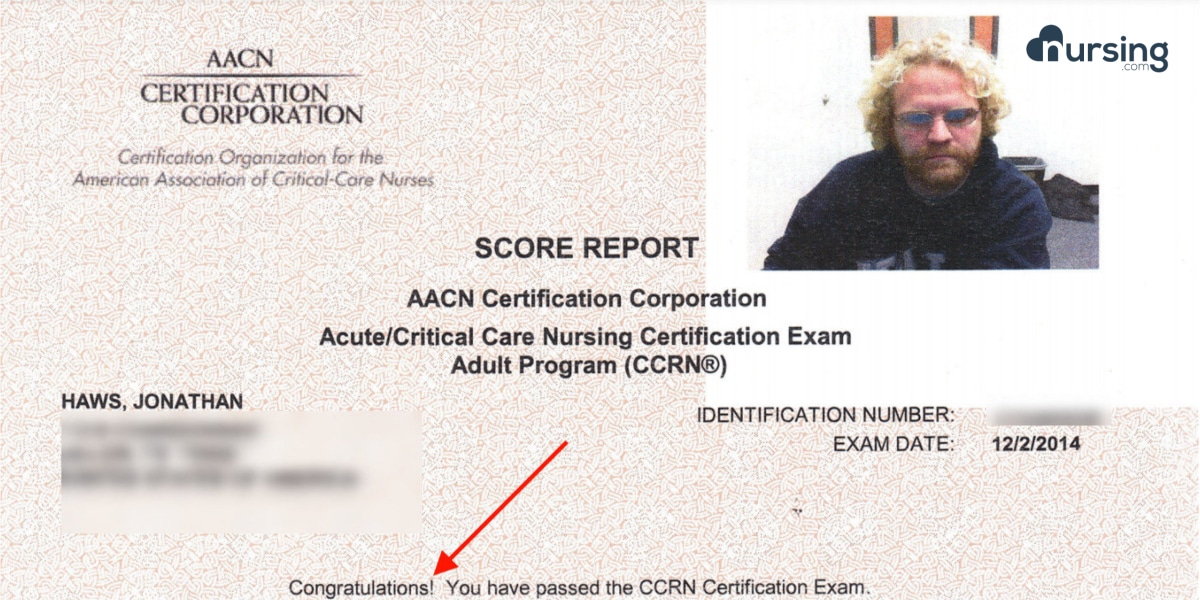
Even when I passed the CCRN certification exam - I felt like an ICU nurse imposter 😩

This was a typlical patient pump in the Neuro ICU 😳
Let's look at the math for a moment:
Now circle back to that feeling that 42% of nursing students have daily—that they're the "dumbest person" in class. It's statistically impossible for nearly half of all nursing students to simultaneously be the "dumbest" in their class. It's a mathematical contradiction.
In other words: your brain is lying to you.
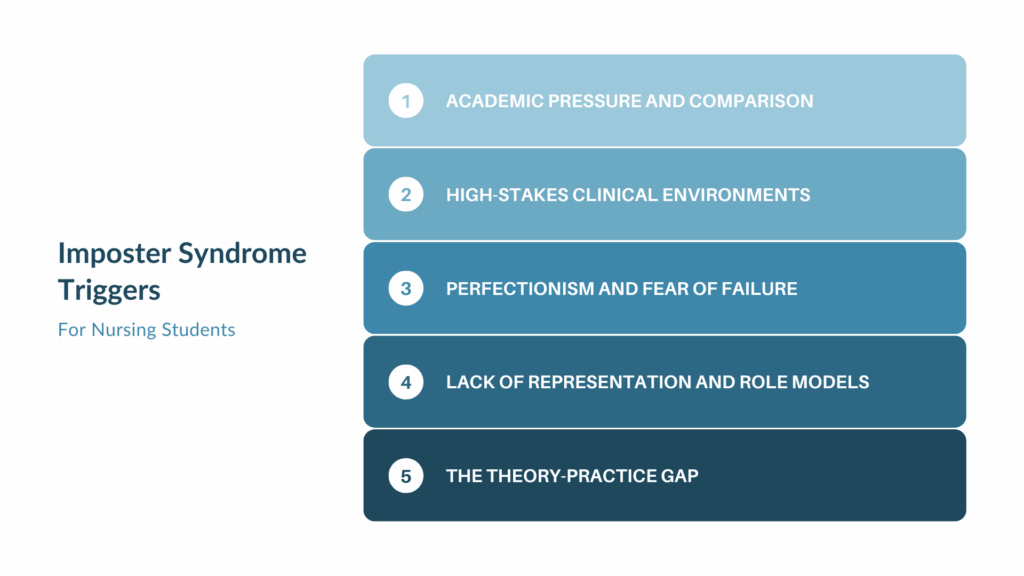
Understanding what activates these feelings can help you recognize and address them:
1. Academic Pressure and Comparison
Rebecca Cadenhead, in her Harvard Magazine article "The Truth About Imposter Syndrome," describes her experience: "I had a similar experience with my economics class, which felt especially problematic because I was supposed to study applied math-economics. By the end of my first semester, I became so insecure that I developed an irritating habit of tacking 'do you know what I mean?' onto my sentences in a genuine, though desperate, plea for affirmation."
The constant comparison to peers creates a distorted perception. You're comparing your internal struggles to others' external composure.
2. High-Stakes Clinical Environments
The transition from classroom to clinical settings is jarring. Suddenly, theoretical knowledge must be applied to real patients with real consequences. Making mistakes in front of instructors, staff nurses, and patients creates intense vulnerability.
3. Perfectionism and Fear of Failure
Many nursing students are recovering perfectionists. The El-Ashry study found that nursing students experiencing imposter syndrome may also exhibit higher levels of emotional distress and burnout, ultimately affecting their academic performance and professional development.
4. Lack of Representation and Role Models
For students from underrepresented groups, imposter syndrome can be magnified by a lack of familiar faces in faculty, leadership, or learning materials. As noted in the Mullangi and Jagsi article, "imposter syndrome disproportionately affects women and minority groups—who often lack sufficient role models of success."
5. The Theory-Practice Gap
There's an enormous gulf between what's taught in the classroom and what's practiced in clinical settings. As one researcher puts it, there is "a massive canyon that exists between nursing school and BEING a nurse."
Recognize the Universality of These Feelings
Almost every classmate around you is experiencing similar doubts. The simple act of acknowledging that you're not alone can be incredibly powerful.
When I started sharing my feelings of inadequacy with trusted classmates, I was shocked to discover they felt the same way. One of my most confident-appearing friends admitted she cried in her car after every clinical day, convinced she would never make it as a nurse.
Collect Evidence Against Your Imposter Thoughts
Start keeping a "success file"—a collection of positive feedback, good grades, clinical wins, and moments where you helped a patient or mastered a skill. When imposter thoughts creep in, review this concrete evidence that contradicts them.
I still keep a folder of emails from students and nurses who have found success through NURSING.com. When I start feeling like a fraud, I open that folder and remind myself of the real impact I've had.
Separate Feelings from Facts
When you catch yourself thinking "I'm the dumbest person here," recognize it as a feeling, not a fact. Try reframing it: "I'm feeling overwhelmed by this new material, which is completely normal when learning complex concepts."
Develop a Growth Mindset
Psychologist Carol Dweck's research on mindset is particularly relevant for nursing students. A "fixed mindset" assumes your abilities are static—you either "get" something or you don't. A "growth mindset" recognizes that abilities develop through dedication and hard work.
Nursing knowledge isn't innate—it's acquired through study, practice, mistakes, and persistence. The most successful nurses aren't those who never struggled; they're the ones who kept going despite the struggles.
Practice Self-Compassion
Would you tell a struggling classmate they're "too dumb" for nursing school? Of course not. Apply that same kindness to yourself. Research shows that self-compassion is more motivating than self-criticism when it comes to overcoming failure.
Focus on the Journey, Not Just the Destination
Olympic marathoner John Stephen Akhwari, who finished last in the 1968 Olympics after suffering an injury, said: "My country did not send me 5,000 miles to start the race. They sent me 5,000 miles to finish the race."
Your nursing journey isn't about being the best or brightest—it's about becoming the compassionate, skilled nurse your future patients need.
Perhaps the most powerful shift we can make is changing how we define success in nursing education.
Success isn't about knowing everything or never struggling.
It's about:
As noted in the University of Mississippi Medical Center School of Nursing's research on student retention: "The World Health Organization has predicted a shortage of over 18 million healthcare professionals by 2030, with half of those individuals representing the nursing profession."
The world doesn't need perfect nurses who never doubted themselves. It needs dedicated, compassionate nurses who persevered through their doubts to provide excellent care.
There's a profound insight hidden in the Harvard Magazine article on imposter syndrome: "Ultimately, I think we should question whether we're worthy of the enormous benefits of having gone to Harvard. Really, there's a way in which 'imposter syndrome' is a form of self-awareness."
Applied to nursing, this suggests something powerful: perhaps what you're interpreting as "being the dumbest" is actually a healthy awareness of the immense responsibility nursing entails.
It takes intelligence to recognize how much you don't know. It takes humility to acknowledge the gaps in your knowledge. And it takes courage to show up anyway, determined to learn and grow.
The students who worry me most aren't the ones who feel like imposters—they're the overconfident ones who don't recognize the limits of their knowledge or the potential consequences of their actions.
Let me share one final personal story. About a year after graduating, I was taking care of a complex stroke patient when a new graduate nurse approached me, looking terrified. "I don't know what I'm doing," she whispered. "I feel like I'm going to hurt someone. Everyone else seems so confident."
I put down my papers and looked her in the eye. "I feel that way too sometimes," I told her. "We all do. The difference between last week and next year isn't that the feeling goes away—it's that you learn to recognize it as a feeling, not a fact."
I watched her shoulders relax slightly. "Really? Even you?"
"Especially me," I said. "But here's what I know for sure: the fact that you care enough to worry about harming a patient means you're exactly the kind of nurse patients need."
That's what I want to tell you now. Your self-doubt isn't evidence that you don't belong in nursing—it's evidence of how deeply you care about doing this right.
The path from imposter to authentic practitioner isn't about eliminating all self-doubt. It's about learning to work alongside it, to recognize it as a normal part of growth rather than proof of inadequacy.
You're not the dumbest person in your class. You're a dedicated student on a difficult journey, feeling exactly what 92% of your peers feel. And someday soon, you'll be the experienced nurse reassuring a terrified new graduate that they belong too.
Because you do belong. And deep down, I think you know that.
Now go out and be your best self today.
Happy Nursing!
References and additional reading: