

Authored by: Jon Haws, BS, BSN, RN, Alumnus CCRN
Nursing Content Reviewed by: Jon Haws, BS, BSN, RN, Alumnus CCRN
Jon Haws, RN is a nurse, educator, and founder of NURSING.com, dedicated to making nursing education easier and more effective. After facing burnout himself, he built NURSING.com to help students pass the NCLEX® with confidence and thrive in their careers.
I still remember the night before my first pharmacology exam.
3 AM. Energy drinks scattered across my desk. Hundreds of flashcards in disorganized piles. My eyes burning from staring at tiny drug names for hours.
And the worst part? I knew nothing was sticking.
Beta blockers, calcium channel blockers, ACE inhibitors, ARBs—the names swirled together in my mind like alphabet soup. The side effects lists seemed endless. The contraindications felt arbitrary. How was I supposed to memorize this much information?
Maybe you've had that same moment. Maybe you're having it right now.

If so, you're not alone. In our recent survey of nursing students, 48% said they desperately needed better memory techniques for pharmacology. Another 39% admitted it feels impossible to keep track of and learn everything. And most telling of all? 0%—literally zero percent—said they felt confident about pharmacology.
That number haunts me. Not a single nursing student feeling confident.
But what if I told you the problem isn't you—it's the way pharmacology is taught?

Research confirms what we all feel: traditional pharmacology education is failing nursing students. A systematic review of teaching methods found that lecture-based approaches were among the least effective strategies for helping students retain pharmacological knowledge.
Meanwhile, the consequences are dire. One study revealed that graduating nursing students scored only 55% on pharmacology knowledge tests and 66% on calculation tests just before entering practice. More than a quarter didn't feel ready to deliver safe medication care.
Think about that. We're sending new nurses into practice feeling unprepared to administer medications—one of the most critical nursing responsibilities.
This isn't just an academic problem. It's a patient safety issue.

By my third semester of nursing school, I was barely keeping my head above water in pharmacology. I had piles of drug cards, dozens of apps, and stacks of textbooks. But nothing helped me retain what I needed to know.
The turning point came during my MedSurg clinicals.
I was assigned to give Zofran to a patient with severe nausea. Before administering it, my clinical instructor asked me a simple question:
"How fast should you push that IV?"
I froze. I had memorized that Zofran was an antiemetic, that it was a 5-HT3 receptor antagonist, that its common side effects included headache and constipation.
But how fast to administer it? I had no idea.
That's when I sat down with my study buddy, Tarang . . .
He was quiet, soft-spoken — a trained pharmacist from India who sat next to me in pharm class. One night, we ended up studying together. Well, I was cramming. He was calmly sketching something in his notebook.
After watching me shuffle through a hundred flashcards, he looked over and asked, almost gently, "Jon, why are you trying to memorize the ocean?"
I laughed, but not because it was funny.
"Because that's what everyone studies pharm. Memorize. Drill. Repeat."
He shook his head, took out a clean sheet of paper, and began to draw.
A simple heart. A set of kidneys. Blood vessels branching out.
Then he pointed to his sketch.
"Beta blockers work here, Jon. ACE inhibitors work here. Diuretics affect this. When you understand where a drug works — which organs, which receptors — the side effects aren't just facts. They're predictable. They make sense."
That moment changed everything.
He wasn't just teaching me pharmacology.
He was teaching me to stop memorizing and start connecting.
To study with purpose. To think like a nurse.
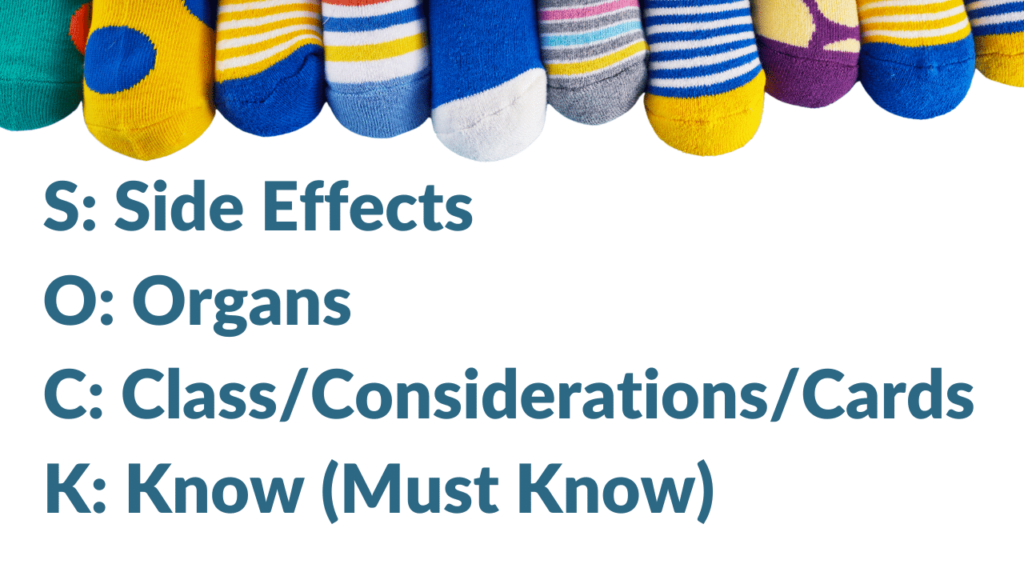
I didn't know it then, but that conversation would become the foundation of what we now call the SOCK Method — a framework built not around memorization, but mastery.
SOCK stands for:
Let me break down exactly how to implement each component in your daily studying.
Pass Your Tests,
Improve Your Grades
Enter a nursing topic and view videos and cheatsheet instantly
Free e-Book
77 Must-Know NCLEX Topics


About NURSING.com
The leading platform for nursing education and NCLEX® prep. Recognized as a top innovator in nursing education, where over 1,000,000+ nursing students gain confidence, improve their grades, and pass the NCLEX®.
Creators of SIMCLEX®, the world's most advanced NCLEX® simulation exam.
Our mission? To end the nursing education struggle and help students become confident, competent nurses.
Pass Your Tests,
Improve Your Grades
Enter a nursing topic and view videos and cheatsheet instantly
What topic are you struggling with?
Take a practice quiz
The Problem: Most students try to memorize every possible side effect, which is both impossible and unnecessary.
The Solution: Categorize side effects into three critical groups:
Practical Application:
Example in Practice: For the antibiotic vancomycin, instead of trying to memorize its 30+ possible side effects, focus on:
This approach immediately cuts your study load by 90% while ensuring you know what matters most for patient safety.
The Problem: Students often treat all body systems equally when studying medications, causing them to miss critical effects on vital systems.
The Solution: Organize your medication study according to this organ system hierarchy:
Practical Application:
Example in Practice: When studying prednisone (a corticosteroid), you would prioritize understanding:
Only after understanding these would you focus on less immediately critical effects like osteoporosis or skin thinning.
Working Through a Specific Example: Let's say you're learning about metoprolol (a beta-blocker). Using the Organs approach:
This organization helps you immediately understand which effects need closest monitoring in different patient populations.
Classes: Learn Medications by Family, Not as Individuals
The Problem: Students try to learn each medication in isolation, missing the patterns that connect similar drugs.
The Solution: Focus on pharmacological classes first, then individual drugs.
Practical Application:
Example in Practice: When learning about calcium channel blockers:
Considerations: The Practical Aspects of Medication Administration
The Problem: Students focus on theoretical knowledge but miss critical practical aspects of giving medications.
The Solution: For each medication or class, identify key nursing considerations in three categories:
Practical Application:
Create a "considerations checklist" for each medication class with these key questions:
Identify "high-alert" considerations that could cause serious harm if missed.
Example in Practice: For heparin administration:
Cards: Creating Effective Study Materials
The Problem: Many students create disorganized or overly detailed drug cards that don't facilitate actual learning.
The Solution: Create streamlined, SOCK-method-based drug cards.
Practical Application:
Sample Template:

The Problem: Students waste time trying to learn every medication equally well.
The Solution: Apply the 80/20 principle to focus your learning on the medications you'll encounter most often.
Practical Application:
Example in Practice:
Tier 1 (Master These First):
Tier 2 (Master After Tier 1):
Tier 3 (Learn for NCLEX and Specialized Situations):
While I've called it SOCK for easy memory, the actual order you should follow when studying is:
Let me walk you through exactly how to apply this to your studying:
Step 1: Begin with Organ Systems (O)
Before diving into specific medications, review the pathophysiology related to the major organ systems. This creates the necessary foundation for understanding how medications work.
Action items:
Step 2: Identify Your Must-Know Medications (K)
Look at your course syllabus, clinical rotation schedule, and NCLEX preparation materials to identify which medications are most important right now.
Action items:
Step 3: Master Classes, Create Considerations, and Make Cards (C)
Now that you know which medications matter most, start learning them by class.
Action items:
Step 4: Focus on Critical Side Effects (S)
Finally, for each medication, identify and learn the most important side effects.
Action items:
Monday
Organ Systems Review (O)
Tuesday
Must-Know Medication Identification (K)
Wednesday
Class Mastery (C - part 1)
Thursday
Individual Drug Cards (C - part 2)
Friday
Side Effect Focus (S)
Weekend
Review and Clinical Connection
The true test of the SOCK method isn't just passing exams—it's applying this knowledge in clinical practice. Here's how each component translates to the bedside:
Side Effects in Practice
When you're administering medications, you'll automatically be alert to the most critical side effects. For example:
Organ System Focus in Assessment
Your organized approach to medication effects on organ systems will structure your assessments:
Class Knowledge in Drug Recognition
Recognizing medication classes becomes second nature:
Prioritization Based on Must-Know Medications
Your clinical focus will shift based on medication importance:
Even with the SOCK method, you'll face challenges. Here's how to address them:
The SOCK method works best for mastering nursing pharmacology because it aligns with how our brains naturally learn. Research in cognitive load theory suggests that our working memory can only handle a limited amount of information at once.
Traditional pharmacology teaching overloads your working memory by bombarding you with disconnected facts. The SOCK method creates mental frameworks—or schemas—that organize information logically, making it easier for your brain to process and store.
Studies support this approach. Research on nursing education has found that:
This isn't just theory—it works. Students who have used the SOCK method consistently report higher grades, better NCLEX results, and most importantly, more confidence in their clinical practice.
Ready to try this approach yourself? Here's how to get started:
This approach builds confidence quickly because you're learning deeply rather than broadly.
I created NURSING.com because I believe nursing education needs to be more than lectures and textbooks. It needs to work with how nurses actually learn and practice.
The SOCK method isn't just an academic tool—it's a clinical framework that will serve you throughout your entire nursing career.
Inside NURSING.com, we've built an entire pharmacology mastery system around this method:
But you don't have to take my word for it. Try it for yourself.
We're offering a free 3-day trial so you can experience how different learning pharmacology can be when you have the right framework.
Before I close, I want to remind you of something important: If you're struggling with pharmacology, it's not because you're not smart enough, not dedicated enough, or not cut out for nursing.
It's because you haven't found the right learning system yet.
The traditional approach to teaching pharmacology simply doesn't work for most students. It's not aligned with how our brains learn, how nurses practice, or what patients need from us.
The SOCK method changed my relationship with pharmacology—and ultimately my confidence as a nurse. It might just do the same for you.
So put on your SOCKs, and let's walk this path together.
❤️ Happy Nursing!
-Jon Haws, RN
Jon Haws, RN, BS, BSN, alumnus CCRN, is the founder of NURSING.com, an online learning platform that has helped over 400,000 nursing students pass the NCLEX and become safe, confident nurses. He developed the SOCK Method based on his own struggles with pharmacology during nursing school.
Have you tried the SOCK method?
References and additional reading:
Discover your pharmacology study personality – and how to finally make pharm click.