
Bloom’s Taxonomy for Nursing Students: Stop Memorizing and Start Thinking Like a Nurse
A lot of nursing students study hard but still feel blindsided by test questions.
They memorize lab values. They memorize disease facts. They memorize signs and symptoms. Then they sit down for an exam, read the question, and suddenly it feels like the test is asking something completely different from what they studied.
That is frustrating, and it usually comes down to one issue.
You are studying at the memorization level, but the exam is testing at the application and analysis level.
That is where Bloom’s Taxonomy comes in.
If you have never heard of it, do not worry. A lot of nursing students have not. But once you understand it, a lot of things start to click. You begin to see why some questions feel easy and others feel like they are trying to trick you. More importantly, you start to understand how to study in a way that actually prepares you for nursing school exams and the NCLEX.
Let’s break this down in a practical way.
What Is Bloom’s Taxonomy?
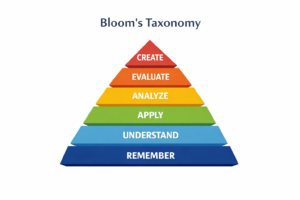
Bloom’s Taxonomy is a framework for thinking about different levels of learning. In plain English, it describes how deeply you understand something.
At the lowest level, you can simply remember a fact.
At the highest levels, you can use that fact, connect it to a patient situation, break down what is happening, and make a safe clinical decision.
That progression matters because nursing is not just about recalling information. Nursing is about using information.
You are not becoming a human flashcard machine. You are becoming someone who can walk into a patient room, notice a subtle change, connect assessment data, and act safely.
That means your studying has to go deeper than simple recall.
A basic way to think about Bloom’s Taxonomy is this:
-
Remember
-
Understand
-
Apply
-
Analyze
Some versions go even further into evaluating and creating, but for nursing students, the most helpful focus is usually on moving from remembering to applying and analyzing.
That is where the real jump happens.
View the Bloom’s Taxonomy Lesson
Why Bloom’s Taxonomy Matters in Nursing School
Here is the big point: nursing exams are usually not trying to see whether you can repeat a fact. They are trying to see whether you can use that fact in a patient care situation.
That is a huge difference.
For example, you might memorize that the normal sodium level is 135 to 145 mEq/L.
Great. That is important. You do need that fact in your head.
But nursing faculty do not stop there, and neither does the NCLEX.
Instead, they may give you a patient with confusion, seizures, fluid imbalance, or very dilute urine and ask you to figure out what is happening. Now you are not just recalling sodium. You are interpreting it in context.
That is what makes a nurse.
Being able to state a normal lab value is helpful. Being able to connect that lab value to what you see at the bedside is where nursing judgment begins.
That is why students who only memorize often feel stuck. They know facts, but they have not practiced using those facts.
The Real Difference Between Memorization and Nursing Thinking
Let’s make this concrete.
A child could memorize a normal sodium level. Plenty of people can memorize numbers. That does not mean they can care for a patient.
A nurse sees data and asks questions.
The nurse notices the Foley bag has very clear urine. The patient is confused. The sodium is low. Now the nurse starts connecting the dots.
That is analysis.
Analysis means you are not just collecting facts. You are breaking down what those facts mean together.
In nursing, that might look like this:
You know a patient has hyponatremia.
You know sodium affects neurological status.
You know fluid balance can dilute sodium.
You know certain conditions or medications can contribute.
You know the patient’s symptoms may reflect that imbalance.
Now you are thinking like a nurse.
This is why students need to stop asking only, “What is the normal value?” and start asking, “Why does it matter?”
The Levels of Bloom’s Taxonomy in Nursing Terms
Let’s walk through the levels in a way that makes sense for nursing students.
Remember
This is straight recall.
You know a fact, definition, list, or normal range.
Examples:
-
Normal sodium is 135 to 145
-
Digoxin is a cardiac medication
-
The signs of hypoglycemia include shakiness and sweating
This level matters. You cannot think critically about information you do not know. Memorization is not bad. It is just not enough by itself.
A lot of students make the mistake of stopping here.
Understand
Now you know what the fact means.
Examples:
-
Sodium helps regulate fluid balance and nerve function
-
Digoxin slows conduction and can affect heart rate
-
Hypoglycemia happens when blood sugar drops too low and the brain is not getting enough glucose
At this stage, you are no longer just repeating words. You understand the concept behind them.
That is progress, but it still is not the level many nursing exam questions are targeting.
Apply
 Now you use the information in a patient scenario.
Examples:
-
You hold digoxin because the apical pulse is too low
-
You recognize that a confused patient with low sodium may be showing symptoms of hyponatremia
-
You give fast-acting carbohydrate to a conscious patient with low blood sugar
Application means you can take what you know and use it in practice.
This is where many nursing questions live.
Analyze
This is where things get harder, and more importantly, where they start feeling more like real nursing.
At the analysis level, you connect multiple pieces of information, identify patterns, distinguish priorities, and figure out what matters most.
Examples:
-
You compare a patient’s intake and output, neuro changes, urine appearance, and lab values to identify a developing fluid and sodium imbalance
-
You recognize that a patient’s symptoms are likely medication related rather than caused by a new disease process
-
You determine which finding is the most concerning and requires intervention first
Analysis is not guessing. It is organized thinking.
This is the level that often separates students who feel confident from students who feel constantly tricked by exam questions.
Why NCLEX-Style Questions Feel So Different
A lot of students say, “I knew the content, but I still got the question wrong.”
Usually that means the student prepared at one cognitive level and got tested at a higher one.
For instance, if you studied by making flashcards of definitions, you probably prepared for recall.
But if the exam asks which patient finding should be reported first, which intervention is most appropriate, or what the nurse should conclude from several assessment findings, that question is testing application or analysis.
That is why the NCLEX and many nursing school exams can feel less like fact tests and more like judgment tests.
They are asking whether you can think through a clinical problem, not just whether you saw the chapter.
Once you understand that, your whole study strategy should shift.
The Best Study Habit: Ask “Why?”
If you only change one thing in the way you study, make it this:
Start asking why.
Do not stop at the fact.
 Push one level deeper every single time.
Let’s say you are studying sodium.
Do not just write:
Normal sodium: 135 to 145
Ask:
-
Why does sodium matter?
-
What happens when it drops?
-
What symptoms would I expect?
-
What causes it to go down?
-
What assessment findings would go with it?
-
What patient is at risk?
-
What would the nurse monitor?
Now you are building connections.
Those connections are what help you answer harder questions.
The same thing works for every topic in nursing school.
If you are studying heart failure, do not stop at signs and symptoms. Ask why the lungs get wet, why daily weights matter, why sodium restriction matters, and why worsening fatigue can signal poor perfusion.
If you are studying diabetes, do not just memorize insulin types. Ask why timing matters, why hypoglycemia happens, and how assessment findings would change your next step.
That is how you climb Bloom’s Taxonomy.
How to Turn Any Study Topic into Analysis Practice
Here is a simple method you can use with almost anything.
Start with the fact.
Then connect it to the body.
Then connect it to the patient.
Then connect it to the nurse’s action.
For example:
Fact: Potassium affects cardiac conduction.
Body: Too much or too little can disrupt the electrical system.
Patient: The patient may have weakness or rhythm changes.
Nurse’s action: Monitor telemetry, review labs, and identify what needs to be reported.
Now the information is alive. It is not just a sentence in a notebook.
You can do this with:
-
Labs
-
Medications
-
Diseases
-
Procedures
-
Assessment findings
-
Prioritization questions
This one habit builds deeper understanding fast.
Take Nursing Practice Questions for FREE
What Nursing Students Usually Get Wrong About Critical Thinking
A lot of students think critical thinking means knowing more obscure information.
Usually it does not.
Most of the time, critical thinking means using basic information really well.
That is good news.
You do not need to chase the most complicated material first. You need to know the common stuff deeply.
Know your major labs.
Know your core disease processes.
Know your common medications.
Know your assessment priorities.
Then keep asking why and what does this mean for the patient.
Critical thinking is often just strong fundamentals plus smart connections.
That is why students can improve so much by changing how they study, even before they add more hours.
How to Study for Higher-Level Nursing Questions
 If you want to prepare for application and analysis questions, your study methods need to match that goal.
Reading your notes over and over will not do enough.
Instead, try these approaches:
Use patient scenarios.
After you learn a concept, picture a real patient. Ask what you would see, what would concern you, and what you would do first.
Explain concepts out loud.
When you teach something in simple words, you quickly find out whether you really understand it.
Compare similar conditions.
For example, compare hyperkalemia and hypokalemia, or SIADH and diabetes insipidus. Comparison forces deeper thinking.
Practice prioritization.
Ask yourself which finding is most urgent and why. This is one of the fastest ways to build NCLEX-style thinking.
Review rationales, not just answers.
When doing practice questions, the learning is in the rationale. Study why the correct answer is right and why the others are wrong.
What This Looks Like in Clinical Practice
This is not just about passing tests.
This is how safe nursing works.
A nurse walks into a room and notices that a patient who was alert this morning is now sluggish and harder to arouse. The nurse checks the chart, sees lab changes, sees intake and output trends, looks at medications, and starts piecing the problem together.
That is Bloom’s Taxonomy in action, even if nobody calls it that.
The nurse is recalling facts, understanding what they mean, applying them to the patient, and analyzing the full picture.
That is the goal of nursing education.
Not perfect memorization.
Not reciting textbook lines.
Clinical judgment.
The Big Takeaway for Nursing Students
Memorization has a place. You absolutely need a solid knowledge base.
But if you want to do well in nursing school, feel more confident with NCLEX-style questions, and actually grow into a safe nurse, you cannot stop there.
You have to move past remembering and into understanding, application, and analysis.
That happens when you get curious.
Ask why.
Ask what it means.
Ask what you would see in the patient.
Ask what the nurse should do next.
That is how you go from studying like a student who hopes to pass to studying like a future nurse who understands what matters.
And once you start doing that consistently, exam questions stop feeling random.
They start feeling familiar.
Because now you are not just memorizing nursing.
You are learning how to think like a nurse.