
Why Learning Style Matters More Than You Think in Nursing School
One of the biggest mistakes nursing students make is assuming that struggling means they are not smart enough. In reality, many students struggle because the way information is being taught does not match the way their brain learns best.
Nursing school is relentless. There is an endless stream of information and it never truly slows down. Even if you somehow memorized every word of a drug guide, new medications would already exist by the time you finished. Memorization alone is not the goal. Understanding is.
The better you understand how the body works, the easier it becomes to understand disease processes, medications, and patient responses. That level of understanding takes time, and nursing students do not have time to waste using study methods that do not work for them.
Knowing your learning style early allows you to focus your limited study time on approaches that actually stick.
Learning Style Is More Than Preference
 Learning style is often described casually, like preferring videos over reading. For some students, it goes much deeper than that.
For students with learning differences such as dyslexia, dysgraphia, or ADHD, certain learning methods are not just less effective, they are significantly more difficult. These students are not broken. Their brains simply process information differently.
You may also find that you use more than one learning style. That is a strength. The more ways you engage with content, the stronger your understanding becomes.
The key is awareness. Once you understand how you learn best, you can start working with your brain instead of fighting it.
(How NURSING.com helps students with ADHD)
Common Learning Styles in Nursing Students
Many nursing students recognize themselves immediately when learning styles are explained.
Some students are kinesthetic learners. They learn best by doing. They understand concepts once they physically perform a task or actively work through a process. Being shown is better than being told. Reading instructions alone is often the hardest method for them.
Others learn best visually. Diagrams, charts, flow sheets, and written outlines help information make sense.
Some students benefit from auditory learning, especially when concepts are explained clearly and reinforced through discussion.
Most students are not just one type. The goal is to identify which methods make learning easier and faster for you, then intentionally use them.
(How NURSING.com helps students with Anxiety)
The Reality of Nursing Education
 Here is an important truth that often brings relief.
Nursing instructors are limited.
Boards of nursing dictate what must be taught. Schools dictate how courses are structured. Third parties often control exam questions. Faculty have limited time, large class sizes, and strict requirements. This means teaching is often not tailored to every learning style.
There is a term for this called dysteachia. It refers to incompatible teaching, where the teaching style does not meet the learner’s needs. This is not about blame. It is about recognizing barriers.
Students cannot rewire their brains. But they can adapt how they study outside the classroom.
If your lectures do not make sense to you, it does not mean you cannot learn the material. It means you may need different tools.
You Can Learn This Material, Even If It Feels Impossible
This is where many nursing students give up too early.
You may not be taught in a multimodal way that fits your learning style. That does not mean you cannot succeed. It means you need to seek out resources that present information differently.
Textbooks, videos, case studies, simulations, and question banks all teach the same content in different ways. Your job is to find the methods that work for you and use them consistently.
Platforms like NURSING.com exist specifically to provide multiple learning formats because no single method works for everyone.
Three Learning Strategies That Work for All Learning Styles
No matter how you learn best, these three strategies can dramatically improve retention and understanding. They come from the book Ultralearning and are especially powerful for nursing students.
1. Learn the Skill Where You Will Apply It
Transfer of knowledge is hard. This is the ability to take information learned in one environment and apply it in another. In nursing, this is what we call clinical judgment.
If you are learning arterial blood gases, study them in the context of a patient chart. If you are learning medications, study them in patient scenarios. If you can physically place yourself in a clinical-like setting, even better.
When full realism is not possible, scenarios still work. Case studies help your brain connect information to real use instead of isolated facts.
If you get stuck because you cannot remember steps, pause and drill briefly. Memorize what you need, then immediately return to applying it in context.
2. Use Free Recall Instead of Endless Review
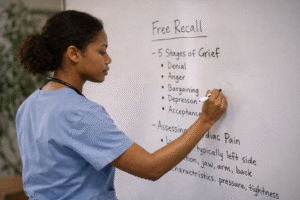 This strategy feels uncomfortable, which is why it works.
Study a topic once. Then close the book. Without looking, write or say everything you remember. This forces your brain to retrieve information instead of just recognizing it.
Recognition feels productive but does not last. Retrieval builds long-term memory.
This is why sometimes you cannot remember a name, then suddenly recall it later when you return to the same environment. The memory was there, you just needed the right trigger.
Free recall strengthens those pathways.
(How NURSING.com helps students with Dyslexia)
3. Get Feedback as Quickly as Possible
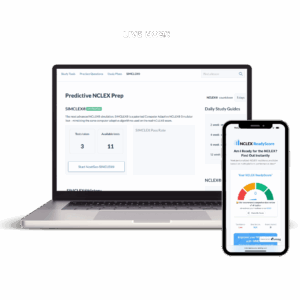
Feedback accelerates learning, but only when it focuses on performance, not personal judgment.
Quizzes, practice questions, instructor comments, and rationales all provide feedback. Use them often.
Avoid feedback that attacks you as a person. Statements like “you are slow” are not helpful. Statements like “this step was missed” are.
Immediate feedback helps you adjust before mistakes become habits.
Nursing School Is Hard, But It Is Not Hopeless
 There will be moments when you feel like you are never doing enough. That feeling is common. It does not mean you are failing.
Understanding how you learn gives you control in a system that often feels overwhelming. It allows you to study smarter, not longer.
You are capable of learning this material. You may just need a different approach.
Believe that. Build systems that support it. And keep going.