
Why Knowing Normal Values Matters in Nursing
If you spend any time around experienced nurses, you will hear them say something like this:
“Something just isn’t right with this patient.”
That instinct does not come from magic. It comes from knowing what normal looks like.
As a nursing student, one of the most important foundations you can build is the ability to recognize normal patterns in your patients. Once you know what normal looks like, you can quickly recognize when something starts drifting in the wrong direction.
That skill matters in three huge areas of nursing practice:
-
Lab values
-
Heart rhythms
-
Neurological status
When you understand these well, you will start catching subtle patient changes earlier, thinking more like a nurse on exams, and making safer clinical decisions.
Let’s break this down in a way that actually sticks.
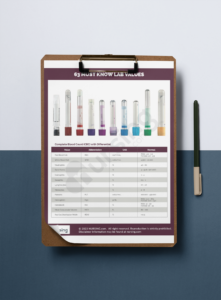
Get a FREE cheatsheet of 63 Must Know Lab Values
Why Nurses Must Know Normal Before They Can Spot Abnormal
In nursing, you are constantly interpreting data.
Your patient’s chart is full of information:
-
Vital signs
-
Lab results
-
Telemetry rhythms
-
Assessment findings
-
Neurological responses
Every single one of those data points only means something if you know the expected range.
Think of it this way.
If a potassium level comes back at 5.8, is that good or bad?
If you do not know the normal potassium range, that number is meaningless.
But if you know that potassium normally sits around 3.5 to 5.0 mEq/L, you immediately recognize that 5.8 is elevated. Now you start thinking about the consequences. High potassium can affect cardiac conduction and potentially cause dangerous heart rhythms.
That is how clinical reasoning begins.
You compare what you see with what you expect.
Without knowing normal, you cannot do that comparison.
And that means you miss early warning signs.
The Three Normal Ranges Every Nursing Student Should Master
There are a lot of numbers in nursing school. It can feel overwhelming at first.
But if you focus on three core areas, you will cover a huge portion of what shows up on exams and in clinical practice.
Let’s look at the big three.
1. Normal Lab Values
Lab values tell you what is happening inside the patient’s body. They reveal changes that might not be visible yet in the patient’s symptoms.
Some of the most important labs every nursing student should know include:
-
Sodium: 135 to 145 mEq/L
-
Potassium: 3.5 to 5.0 mEq/L
-
Calcium: 8.6 to 10.2 mg/dL
-
Glucose: 70 to 110 mg/dL fasting
-
Hemoglobin: 12 to 18 g/dL depending on sex
-
White blood cells: 4,000 to 11,000
These numbers matter because they guide your clinical thinking.
For example:
A patient with low potassium might develop muscle weakness and cardiac rhythm disturbances.
A patient with high white blood cells might be fighting an infection.
A patient with low hemoglobin may have reduced oxygen carrying capacity.
On exams, many NCLEX style questions expect you to recognize abnormal lab values quickly. In the clinical setting, recognizing these changes early can help prevent complications.
This is why memorizing core lab ranges is one of the best study investments you can make.
2. Normal Heart Rhythms

Heart rhythms tell you how well the electrical system of the heart is functioning.
The most important rhythm to recognize first is normal sinus rhythm.
A normal sinus rhythm typically has:
-
Heart rate between 60 and 100 beats per minute
-
A P wave before every QRS complex
-
A consistent rhythm
-
Narrow QRS complexes
Once you understand what a normal rhythm looks like, abnormal rhythms become easier to identify.
For example:
If the heart rate jumps to 140 beats per minute, you might suspect tachycardia.
If the rhythm becomes irregular and chaotic without P waves, you might be looking at atrial fibrillation.
The key point here is simple.
You cannot recognize dangerous rhythms if you have not trained your eye to recognize the normal pattern first.
Many experienced nurses can glance at a telemetry monitor and instantly recognize something is wrong. That skill develops through repeated exposure to normal rhythms.
3. Normal Neurological Status
The brain is extremely sensitive to changes in oxygen, blood flow, and metabolic balance. Even subtle changes in neurological status can signal serious problems.
A normal neurological assessment often includes:
-
Patient is alert and oriented
-
Pupils are equal, round, reactive to light
-
Speech is clear
-
Motor strength is equal bilaterally
-
Patient responds appropriately to questions
When neurological status changes, it can indicate serious issues such as:
-
Stroke
-
Hypoxia
-
Infection
-
Medication effects
-
Head injury
One of the earliest warning signs that something is wrong with a patient is a change in mental status.
Maybe the patient becomes confused.
Maybe they are harder to wake up.
Maybe they stop responding appropriately.
If you know what their baseline neurological status should be, you will recognize those changes much faster.
Knowing the Patient’s Normal Matters Too
Here is something that often surprises nursing students.
Normal ranges are important.
But your patient’s personal baseline can matter even more.
 Every patient is different.
Some patients are naturally more sleepy, slower to respond, or slightly confused due to chronic conditions.
For example, imagine a patient whose baseline neurological status is mildly somnolent. They may wake slowly and answer questions with short responses.
If you walk into the room and see that same presentation, it may be completely normal for that patient.
But if a patient who was alert earlier suddenly becomes difficult to wake, that is a major red flag.
The key idea here is this.
You are not only comparing your patient to textbook normal ranges.
You are also comparing them to their own baseline.
That comparison helps you catch subtle but important changes.
The Role of Nursing Handoff in Protecting Patient Safety
One of the most critical times for communication in nursing is shift change.
This is when responsibility for patient care moves from one nurse to another. If important baseline information is not shared, confusion can happen quickly.
Imagine this situation.
You cared for a patient all day who was somewhat drowsy but easily arousable. That was their normal neurological baseline.
Now imagine you forget to mention that during report.
The next nurse walks into the room, tries to wake the patient, and the patient responds slowly.
Without context, the nurse might think something is wrong.
This can lead to unnecessary panic or unnecessary interventions.
Good handoff communication prevents that.
 When giving report, make sure you communicate important baseline information such as:
-
The patient’s typical mental status
-
Their usual pain level
-
Any chronic rhythm abnormalities
-
Lab trends that are expected
This helps maintain continuity of care, which is essential for patient safety.
How Nursing Students Can Memorize Normal Values More Easily
Let’s be honest.
Memorizing numbers is not the most exciting part of nursing school.
But there are ways to make it easier.
First, focus on high yield values. Do not try to memorize every possible lab at once.
Start with:
-
Electrolytes
-
Hemoglobin
-
White blood cells
-
Glucose
Second, use repetition. Write them down, quiz yourself, and practice applying them to case scenarios.
Third, connect numbers to real patient outcomes.
For example:
High potassium affects the heart.
Low sodium affects the brain.
Low hemoglobin affects oxygen delivery.
When numbers are tied to physiology, they become easier to remember.
The Skill That Turns Students Into Real Nurses
The transition from nursing student to confident nurse happens when you start recognizing patterns.
You see a lab value and immediately know what it means.
You glance at a telemetry monitor and recognize the rhythm.
You assess a patient and sense that something has changed.
That ability starts with knowing normal.
When you know normal lab values, normal neurological findings, and normal heart rhythms, you gain a powerful advantage.
You begin catching patient deterioration earlier.
You become more confident during clinicals.
You perform better on exams.
And most importantly, you become a safer nurse for your patients.
So when you sit down to study, spend time mastering the basics.
Know the numbers.
Know the patterns.
Know what normal looks like.
Because once you know normal, spotting abnormal becomes much easier.