
Why the Nursing Process Matters More Than You Think
If there is one framework that shows up everywhere in nursing school, it is the nursing process.
You will see it in lecture, care plans, clinical paperwork, simulation labs, exams, and eventually the NCLEX. At first it can feel like just another acronym you are expected to memorize. But the truth is that the nursing process is much more than that.
It is the basic structure of how nurses think.
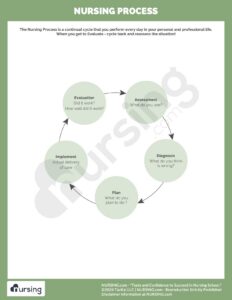
Every shift, every patient interaction, and every clinical decision follows the same logical flow. You gather information, identify problems, plan what to do, carry out the plan, and then see whether it worked.
That framework is called ADPIE:
Assess
Diagnose
Plan
Implement
Evaluate
Some schools present slight variations like AAPIE, but the idea is always the same. The steps may look simple, but understanding how they connect is one of the biggest keys to succeeding in nursing school and answering NCLEX-style questions.
View the Nursing Process Lesson
The Nursing Process Is How Nurses Think
One of the biggest transitions in nursing school is learning to think like a nurse instead of just memorizing information.
The nursing process helps you do that.
Instead of reacting randomly or jumping to conclusions, nurses follow a structured way of thinking. Each step builds on the previous one. Skipping steps can lead to incorrect decisions or unsafe care.
This is also why exam questions often revolve around the nursing process. Test writers want to see if you understand the correct order of thinking.
When a question asks, “What should the nurse do first?” the answer is often connected to where you are within the nursing process.
Understanding this sequence turns confusing questions into manageable ones.
Step One: Assessment Comes First
Assessment is always the starting point.
This step involves gathering information about the patient. You cannot make safe decisions without understanding what is actually happening.
Assessment includes:
-
Observing the patient
-
Taking vital signs
-
Reviewing lab results
-
Asking questions
-
Performing physical exams
-
Reviewing patient history
-
Noticing symptoms and changes
Essentially, assessment is collecting data.
Imagine a patient who reports shortness of breath. Before deciding what interventions to perform, you need to assess things like oxygen saturation, respiratory rate, lung sounds, and level of distress.
Without assessment, any action you take is based on guesswork.
This is why many NCLEX questions have assessment as the correct answer. If information is missing, the safest action is usually to gather more data first.
However, this does not mean assessment is always the correct answer. This is where many students get tricked.
Step Two: Nursing Diagnosis
Once you have gathered information, the next step is identifying the problem.
This step is the nursing diagnosis.
A nursing diagnosis focuses on patient responses to health conditions rather than medical diseases. For example, a medical diagnosis might be pneumonia, but the nursing diagnosis might focus on impaired gas exchange or ineffective airway clearance.
The goal here is identifying what nursing problem needs to be addressed.
In exam questions, sometimes the assessment is already complete. When the problem is clearly identified, the next step is not more assessment. The next step is moving forward in the nursing process.
This is where students often get stuck.
They remember that “assessment comes first,” but they forget that the question might already provide the assessment.
Step Three: Planning Care
After identifying the problem, the nurse creates a plan.
Planning involves deciding what goals should be achieved and what interventions will help the patient reach those goals.
Planning often includes:
-
Setting measurable patient goals
-
Determining nursing interventions
-
Prioritizing patient needs
-
Identifying expected outcomes
For example, if a patient has impaired gas exchange, the plan might include improving oxygenation, encouraging deep breathing, and monitoring oxygen saturation.
Planning is where the strategy comes together. It connects the patient problem with the actions the nurse will take.
In clinical practice, this step may happen quickly in your head. In nursing school, it often shows up as written care plans.

Step Four: Implementation
Implementation is where the nurse carries out the plan.
This is the action phase.
Examples of implementation include:
-
Administering medications
-
Providing oxygen therapy
-
Repositioning the patient
-
Educating the patient
-
Performing wound care
-
Starting IV fluids
-
Communicating with the healthcare team
Many students assume implementation is always the first thing to do, but it is actually the fourth step in the process.
Jumping straight to implementation without assessment or planning can lead to mistakes. That is why nursing education emphasizes following the full process.
In NCLEX-style questions, if the problem has already been identified and a plan exists, implementation may be the correct next step.

Step Five: Evaluation
The final step is evaluation.
This step asks a simple but important question: Did the intervention work?
Evaluation involves reassessing the patient and determining whether the expected outcomes were achieved.
For example:
-
Did the patient’s oxygen saturation improve?
-
Is the patient’s pain now controlled?
-
Did blood glucose levels return to normal?
-
Is the wound healing as expected?
If the goal was not achieved, the process starts again. The nurse reassesses the patient and adjusts the plan accordingly.
Evaluation ensures that nursing care is effective and responsive to patient needs.
View some Case Studies to try it out
Why the Nursing Process Shows Up on Exams So Often
Nursing exams are designed to test clinical thinking, not just memorization.
The nursing process provides a structure that allows exam writers to test whether students understand the correct sequence of care.
A common test question might ask:
“What should the nurse do first?”
Students often feel unsure because multiple answers might seem reasonable. But when you apply the nursing process, the answer becomes clearer.
You simply identify where you are in the process and choose the next logical step.
The Most Common Test Trap: Skipping a Step
One of the most common traps on nursing exams is skipping steps in the nursing process.
For example, a question may tempt you to implement an intervention before gathering necessary data. Or it may encourage you to evaluate something before an intervention has even been performed.
These questions are designed to see if you recognize the correct order.
If you jump ahead, you fall into the trap.
The safest approach is to ask yourself one simple question:
Where am I in the nursing process right now?
Once you answer that question, the next step usually becomes obvious.
A Simple Everyday Example
The nursing process may sound academic, but it actually mirrors how we solve problems in everyday life.
Imagine you feel hungry.
First, you assess the situation. You recognize the feeling of hunger.
Next, you identify the problem. You determine that you need food.
Then you plan what to do. Maybe you decide to cook dinner or order takeout.
After that, you implement the plan. You prepare the food or place the order.
Finally, you evaluate. Are you still hungry, or are you satisfied?
You would not evaluate before eating. That would not make sense.
The same logic applies to nursing care.
How to Use ADPIE During Test Questions
When answering nursing exam questions, follow this simple strategy.
First, identify what information the question has already provided. Has the patient already been assessed? Is the problem already identified?
Second, determine which step of the nursing process you are currently in.
Third, choose the answer that represents the next step.
For example:
If no assessment data is given, assessment is often the correct choice.
If the assessment is complete and the problem is clear, you move toward diagnosis or planning.
If a plan already exists, the next step is implementation.
If an intervention has already occurred, evaluation may be the correct answer.
This approach turns confusing questions into logical ones.
Try some Nursing Practice Questions
Why This Matters in Clinical Practice
 The nursing process is not just a test strategy. It is the foundation of safe patient care.
Healthcare environments are complex and fast paced. Nurses constantly gather information, recognize problems, plan interventions, act, and reassess.
Following this structure helps ensure that decisions are thoughtful rather than reactive.
It also helps nurses communicate effectively with the rest of the healthcare team. When everyone understands the patient problem, the plan, and the expected outcomes, care becomes more coordinated and effective.
The Key Rule: Never Break the Nursing Process
The biggest takeaway is simple.
Do not break the process.
Assess.
Diagnose.
Plan.
Implement.
Evaluate.
When you keep these steps in order, both patient care and exam questions become easier to navigate.
It may seem basic, but mastering this framework is one of the most powerful things you can do as a nursing student.
Final Thoughts
Nursing school introduces an enormous amount of information. It is easy to feel overwhelmed trying to remember everything.
The nursing process gives you a structure that helps organize your thinking.
Instead of guessing what to do next, you follow the logical flow:
Assess the patient.
Identify the problem.
Create a plan.
Carry out the plan.
Evaluate the results.
This framework shows up in exams, clinical decisions, and patient care every day. The more comfortable you become with it, the more confident you will feel in both testing and practice.
When in doubt, step back and ask yourself where you are in the process.
Then simply take the next step.
That is how nurses think.