
Why the Order of Draw Actually Matters
Drawing labs looks simple on the surface. Stick the patient, fill the tubes, send them off. But there is a critical detail that nursing students often underestimate.
The order matters because every blood tube contains a different additive.
Those additives preserve the blood in specific ways. Some prevent clotting. Some preserve glucose. Some stabilize cells. The problem is that if additives from one tube contaminate another tube, the lab results can be altered enough to give false data.
That means a patient could appear to have abnormal labs when they actually do not. It also means repeat sticks, wasted resources, delayed treatment, and unnecessary risk.
This is why the order of draw is not just a memorization task. It is a patient safety concept.
(Learn more about Labs on the NCLEX)
What Causes Lab Contamination
When blood is drawn into tubes sequentially, there is always the potential for trace amounts of additive to carry over. This can happen when using a syringe or during improper tube handling.
For example, lavender top tubes contain EDTA, an anticoagulant. EDTA binds calcium. If EDTA contaminates a tube meant to measure calcium levels, the result can come back falsely abnormal.
That is not a small mistake. Calcium levels influence cardiac rhythm, neuromuscular function, and medication decisions. A contaminated lab can lead to unnecessary interventions.
Understanding this cause-and-effect relationship helps you remember the order instead of just memorizing colors.
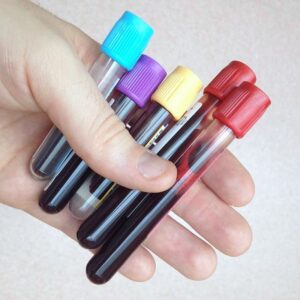
The Most Common Blood Collection Tubes You Will See
 You will encounter many types of tubes in practice, but nursing exams and clinicals focus on a core group.
Blood culture bottles are drawn first. These are sterile containers designed to detect bacteria or fungi in the bloodstream. They must be drawn first to avoid contamination from skin flora or tube additives.
Light blue top tubes are used for coagulation studies. These include tests like PT, INR, and aPTT. These tubes contain sodium citrate and must be filled to the correct volume to ensure accurate results.
Red and green top tubes are used for chemistries. Green tops contain heparin and are often used for rapid chemistry tests. Red tops do not contain anticoagulants and are used for serology and more complex chemistry testing.
Lavender or purple top tubes are used for hematology. These include CBC, hemoglobin, hematocrit, and related tests. They contain EDTA to prevent clotting.
Gray top tubes are used for lactate and blood glucose testing. They contain additives that preserve glucose levels and prevent cellular metabolism from altering results.
This is not a comprehensive list, but it covers the vast majority of what nursing students are tested on.
The Correct Order of Draw for Nursing Students
Here is the standard order you need to know for exams and clinical practice.
First, blood cultures
Second, light blue top tubes for coagulation studies
Third, red or green top tubes for chemistries
Fourth, lavender top tubes for hematology
Fifth, gray top tubes for lactate or glucose
A helpful way to remember this is that the most contamination-sensitive tests go first, and the most additive-heavy tubes go later.
Blood cultures must remain sterile.
Coagulation tests require precise additive ratios.
Chemistries are more forgiving but still sensitive.
Hematology tubes contain strong anticoagulants.
Gray tops are drawn last due to their additives.
(Learn more about the Order of Lab Draws)
What If You Are Not Drawing Every Tube?
This is where students often get confused.
You do not skip the order. You adjust it.
If a patient only needs a BMP and a CBC, you are not drawing blood cultures or coagulation studies. In that case, you start with the chemistry tube first, then the lavender tube.
Green top first.
Lavender top second.
You always follow the relative order of the tubes you are actually drawing.
Do not invent a new sequence. Just remove the tubes that are not needed.
When You Should Consider a Separate Sample
There are times when using one draw for multiple tests is not the best choice.
If you are unsure whether additives could interfere with a specific test, or if the test is expensive or difficult to repeat, drawing a separate sample may be the safest option.
This is a nursing judgment call.
You must balance patient comfort, cost, and accuracy. Drawing an extra sample is sometimes the safer choice if it prevents inaccurate results or repeat sticks later.
When in doubt, ask the lab. Calling the lab is not a weakness. It is good nursing practice.
Exam and Clinical Pearls You Should Remember
The order of draw is a favorite topic for exams because it tests both knowledge and safety awareness.
Always draw blood cultures first.
Never let EDTA contaminate calcium or coagulation tests.
Light blue tubes must be filled completely.
When unsure, consult the lab or draw separate samples.
In real practice, policies can vary slightly by facility. On exams, use the standard order unless told otherwise.
Resources like Nursing.com emphasize understanding the why behind procedures like this because understanding lasts longer than memorization.
Final Takeaway
Drawing labs is not just a technical skill. It is a clinical decision-making process.
Understanding tube additives, contamination risk, and proper sequencing protects your patient and preserves the integrity of their results.
Most of the time, you will be fine. But knowing what to do when you are unsure is what separates a task-doer from a safe nurse.
Learn the order. Understand the reason. Use your judgment.
Happy Nursing!